
New wasp species named after David Attenborough to mark his 100th birthday
Scientists have named a newly identified wasp genus after naturalist David Attenborough ahead of his 100th birthday on 8 May 2026. The specimen had been held in London's Natural History Museum since 1983.
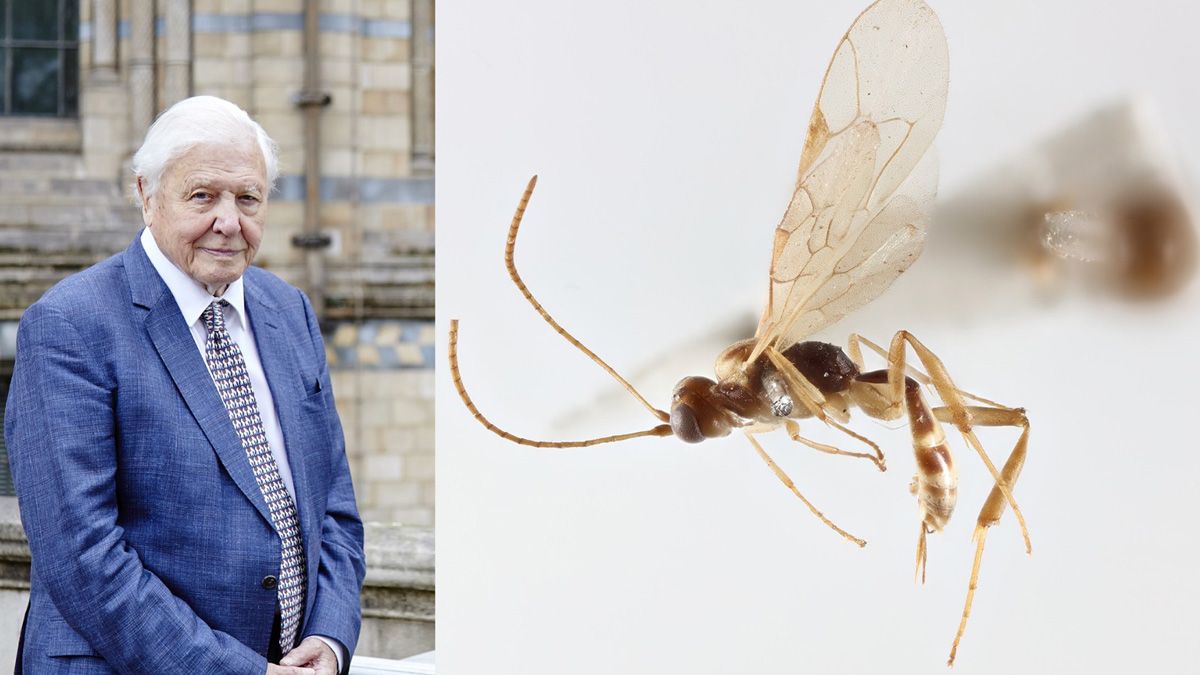

Scientists have formally named a newly identified genus of wasp after the naturalist and broadcaster David Attenborough, timed to coincide with his 100th birthday on 8 May 2026.
The wasp, designated Attenboroughnculus tau, had been held in the collection of London's Natural History Museum since its discovery in Chile in 1983.
The finding was published in the Journal of Natural History. The study was led by Gavin Broad, principal curator of insects at the Natural History Museum, and co-authored by Augustijn De Ketelaere, a museum volunteer who first identified the specimen during a survey of the collection.
A specimen overlooked for more than four decades
The wasp was originally collected from Valdivia province in southern Chile. It remained unexamined in the museum's archives for more than 40 years before De Ketelaere flagged it during a systematic review of the museum's ichneumon wasp holdings.
Ichneumon wasps constitute one of the largest and most geographically dispersed groups of parasitic wasps, with approximately 25,000 identified species. Researchers estimate that a further 75,000 species remain unnamed.
Broad said the delay between collection and classification is not unusual. "Taxonomic discovery is sometimes really quick — you find something and you describe it right away," he noted. "But sometimes it's quite slow, and you just work methodically through the collections that other people have accumulated over the years."
A new genus, not merely a new species
Upon closer examination, the specimen proved to represent not only a previously unknown species but an entirely new genus — a higher-order taxonomic grouping that signifies a more significant and rarer finding.
Broad explained that the specimen's physical characteristics could not be reconciled with any existing genus. "We looked at it, and we had a good look at all its relatives," he said, "and we realised it's got a combination of characters that meant it wouldn't fit anywhere. So, we had to describe a new genus to accommodate this lovely little species."
The wasp measures 3.5 millimetres in length, has a slender curved abdomen, and belongs to a small subfamily of wasps native to Chile, Argentina, Australia, and New Guinea.
Broad described this distribution as unusual, attributing it to the ancient supercontinent Gondwana, which began breaking apart approximately 180 million years ago. "These little wasps have clung on to what used to be Gondwana, and they've probably gone extinct in the rest of the world," he said.
The naming and its significance
Species nomenclature follows the binomial system devised by the Swedish naturalist Carolus Linnaeus in the 1750s, which assigns each organism a two-part Latin or Latinised name identifying its genus and species respectively. In the case of Attenboroughnculus tau, the tribute to Attenborough is embedded in the genus name. The species designation tau refers to T-shaped markings on the insect's abdomen, which resemble the Greek letter of the same name.
Broad explained that naming a genus after a person carries greater weight than naming a species, because new genera are identified far less frequently. "Naming a genus after somebody is quite special," he said. "David Attenborough deserves a genus. I think everybody would agree with that."
Broad also credited Attenborough's television work as the source of his own early interest in natural history. "I grew up watching Life on Earth and Living Planet and reading his books, and it's thanks to David Attenborough that I sort of knew what a taxonomist was," he said.
Attenborough responded to news of the naming by sending Broad a handwritten note of thanks.
A career spanning seven decades
Born on 8 May 1926 in Isleworth, England, Attenborough made his television debut on the BBC in 1954 with the series Zoo Quest. He has since become one of the most recognised voices in natural history broadcasting and documentary filmmaking.
He has been knighted twice and holds more than 30 honorary degrees. In 2011, at the age of 84, he became one of the oldest people to visit the North Pole, during filming of the Frozen Planet series. He continues to work, having recently narrated a series on urban wildlife titled Secret Garden.
More than 50 species across multiple kingdoms of life have been named in Attenborough's honour, including fish, spiders, birds, lizards, beetles, and snails, as well as various plant and wasp species. In most instances the species name incorporates his surname directly, as in the case of Zaglossus attenboroughi, an endangered echidna found in New Guinea.
Some tributes are more oblique. The oceanic phytoplankton Syracosphaera azureaplaneta takes its species name from a Latinisation of The Blue Planet, the landmark marine documentary Attenborough narrated in 2001.
Several genera have also been named after him, including Sirdavidia, a genus of trees found in Gabon, and Attenborosaurus, a genus of extinct Jurassic marine reptiles. The Chilean wasp now joins that rare company.
Broad reflected on the broader significance of Attenborough's legacy for scientific understanding. "He's opened up so many different groups of organisms, plants and animals, and shown what they're actually doing out there," he said. "And lately he's been an incredible advocate for threatened species, telling us that we should be doing something to stop our destruction of the natural world."
Researchers also noted that the discovery carries implications beyond taxonomy. A species cannot be legally protected from extinction unless it has been formally named and classified, underscoring the importance of continued investment in the field at a time when the global community of practising taxonomists remains critically understaffed.