Hong Kong airport opens revamped Terminal 2 in US$14.5 billion capacity push
Hong Kong International Airport launched its revamped Terminal 2 on 27 May 2025, targeting 30 million passengers annually as part of a US$14.5 billion expansion to reach 100 million fliers per year and compete with Singapore and Dubai.
- Terminal 2 opened 27 May as part of a US$14.5 billion expansion targeting 100 million annual passengers.
- Fifteen airlines will migrate check-in operations to Terminal 2 in phases by mid-June 2025.
- Boarding gates remain at Terminal 1 until Terminal 2's own concourse is completed late next year.

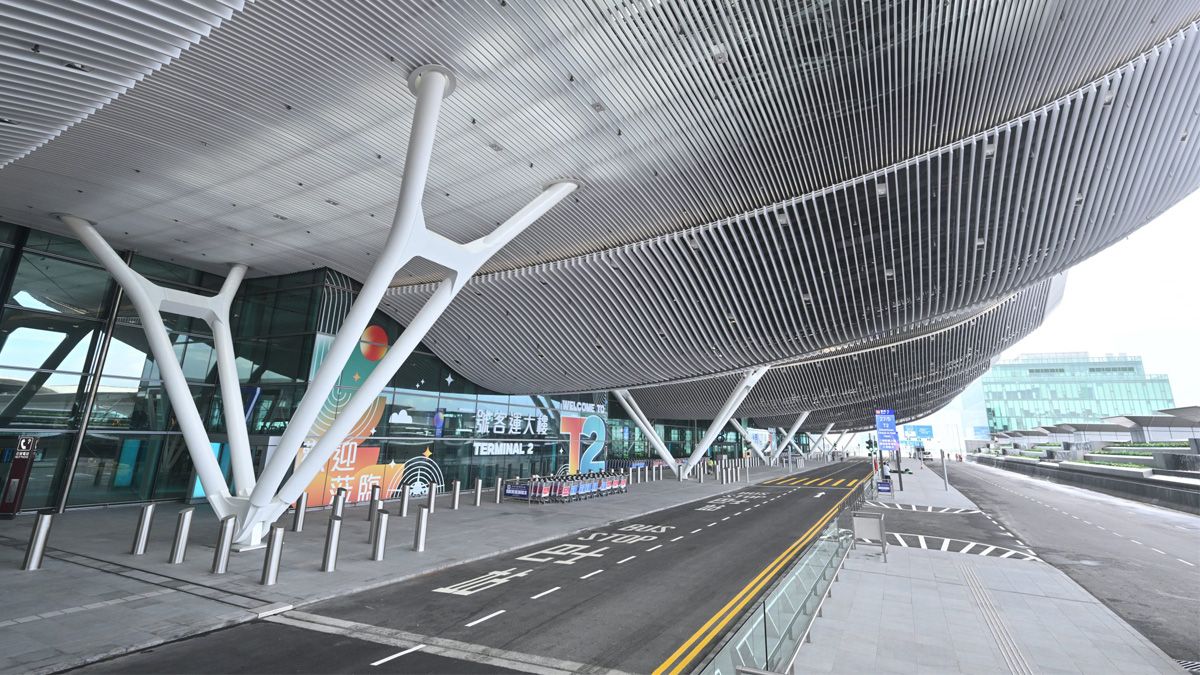
Hong Kong International Airport (HKIA) opened its revamped Terminal 2 (T2) on Wednesday, 27 May 2025, as part of a US$14.5 billion expansion programme intended to raise the airport's total annual capacity to 100 million passengers and sharpen its competitive edge against Singapore Changi and Dubai International.
Around 4,200 passengers were expected to use the new departure facilities on opening day. Hong Kong Airlines operated the terminal's inaugural flight, departing for Shanghai Pudong in the early morning hours, with passengers beginning to arrive from around 5am local time.
The first day's milestone
Fred Lam, Chairman of the Airport Authority Hong Kong (AAHK), described the opening as a landmark moment for the airport's development.
Speaking at the inauguration ceremony, Lam said T2 was "positioned as a terminal for leisure travel," with a design that "prioritises efficiency and passenger comfort" and makes extensive use of technology to enable self check-in, self bag-drop, and smooth immigration clearance.
Acting Financial Secretary Michael Wong said the government would continue to adopt a "multi-pronged approach" to strengthen HKIA's position as an international aviation hub, including accelerating the expansion of the aviation network, enhancing intermodal connectivity with the Greater Bay Area, and advancing the development of the Airport City.
Wong added that Hong Kong would "proactively align with and work on the National 15th Five-Year Plan" to fully support its role as an international aviation hub.
A digitally advanced facility
Spanning 300,000 square metres, T2 is designed to serve both departing and arriving passengers, though only departure facilities were commissioned on 27 May. Arrival facilities are expected to begin operations next year, in line with projected traffic demand.
The departures hall features eight check-in aisles — designated P to W — with 108 hybrid check-in counters, 58 smart check-in kiosks, and 68 express self-bag-drop counters. All self-bag-drop and hybrid counters are built with an ultra-low platform design, allowing passengers to place luggage onto conveyor belts without lifting.
Airport officials described T2 as the world's most digitally advanced passenger terminal. Artificial intelligence, robotics, and facial recognition technology are embedded throughout to process up to 30 million passengers annually.
Vivian Cheung Kar-fay, chief executive of the AAHK, said operations ran smoothly on opening morning. She highlighted that self check-in systems allow departing passengers to complete the entire check-in process in as little as 45 seconds.
The terminal's 20 e-Security Gates at the entrance to the restricted area are equipped with facial recognition technology. In tandem with T2's opening, the minimum age for using facial recognition at e-Security Gates has been lowered from 11 to 7 in both Terminal 1 and T2.
Inside the restricted area, 15 smart security screening channels allow passengers to keep laptops and bottled liquids under 100 millilitres in their carry-on luggage during screening. The Immigration Department has installed 35 e-Channels and 60 counters for departing passengers.
Passenger response
Passengers on opening day offered broadly positive assessments of the new facility, with most noting its efficiency and ease of use.
A traveller identified as Feng, who saw her mother off on a midday flight to Shanghai, said the check-in process took just three to five minutes with no waiting. She described the bag-drop facility as far more user-friendly than Terminal 1.
"You just lay your luggage directly on the belt. Before, you had to lift it up. It's very convenient," she said.
Feng noted, however, that their taxi had mistakenly dropped them at Terminal 1, requiring them to walk to the new building.
A traveller identified as Chow, who was travelling to Bangkok with his family, said it would be better if passengers checking in at T2 could board directly from the same terminal.
"It just makes everyone's life a lot easier, especially for the elderly or people with younger kids like us," he said.
Cheung acknowledged the concern but explained that the phased approach was aligned with current passenger demand. She said the journey to Terminal 1's boarding area via the automated people mover (APM) was a "seamless" process, and that extra staff would be deployed during the initial two days to help passengers navigate.
Abundant signage has been installed throughout the terminal, Cheung said, to ensure that passengers who take a wrong turn can readily find their way to the correct building.
After completing check-in and security procedures at T2, passengers must still travel via the APM to the boarding gates in Terminal 1. T2's own departure concourse and boarding gates are not expected to be completed until late 2026.

Phased airline migration
Fifteen airlines are scheduled to migrate their check-in operations to T2 in phases by mid-June 2025, with six additional carriers beginning operations there on Thursday, 28 May. Hong Kong Airlines was the first carrier to relocate, operating both the inaugural morning departure to Shanghai Pudong and the final departure of the day to Osaka.
The airlines set to operate from T2 are primarily budget and leisure carriers, including AirAsia, Hainan Airlines, Cambodia Airways, IndiGo, Bangkok Airways, and Cebu Pacific. Their migration is intended to free up capacity at Terminal 1 for mainline carriers such as Cathay Pacific Airways.
The strategic context
HKIA ranked as the world's eighth-busiest international airport by seat capacity in 2025, with a total of 38.7 million seats, according to aviation data firm OAG. That placed it behind Dubai International Airport's 62.4 million and Singapore Changi's 42.6 million.
Steven Yiu, HKIA's executive director of airport operations, said at a briefing ahead of the official opening that T2 was "really important for HKIA because it provides extra capacity for us to grow."
Airport officials also noted that the ongoing conflict in Iran had disrupted air travel through Middle East gateways, including Dubai and Doha. Asian hubs, including Hong Kong, Singapore, and Seoul, are seeking to capitalise on the resulting traffic diversion.
The expansion also includes a now-operational third runway, which forms part of the broader infrastructure programme underpinning HKIA's ambition to reach 100 million passengers a year.
T2 is expected to serve eight million passenger trips in its first year of operation, with a long-term design capacity of 30 million passengers annually.