Singapore remains Indonesia’s top investor as trade deficit widens ahead of leaders’ retreat
Indonesia’s trade deficit with Singapore widened in the first half of 2026 even as Singapore retained its position as Indonesia’s largest foreign investor ahead of the annual Indonesia–Singapore Leaders’ Retreat in Jakarta.
- Indonesia recorded a US$3.83 billion trade deficit with Singapore during the first half of 2026.
- Singapore remained Indonesia’s largest foreign investor with US$4.6 billion in realised investment during the first quarter.
- The annual Leaders’ Retreat is expected to produce 26 memoranda of understanding across strategic sectors.

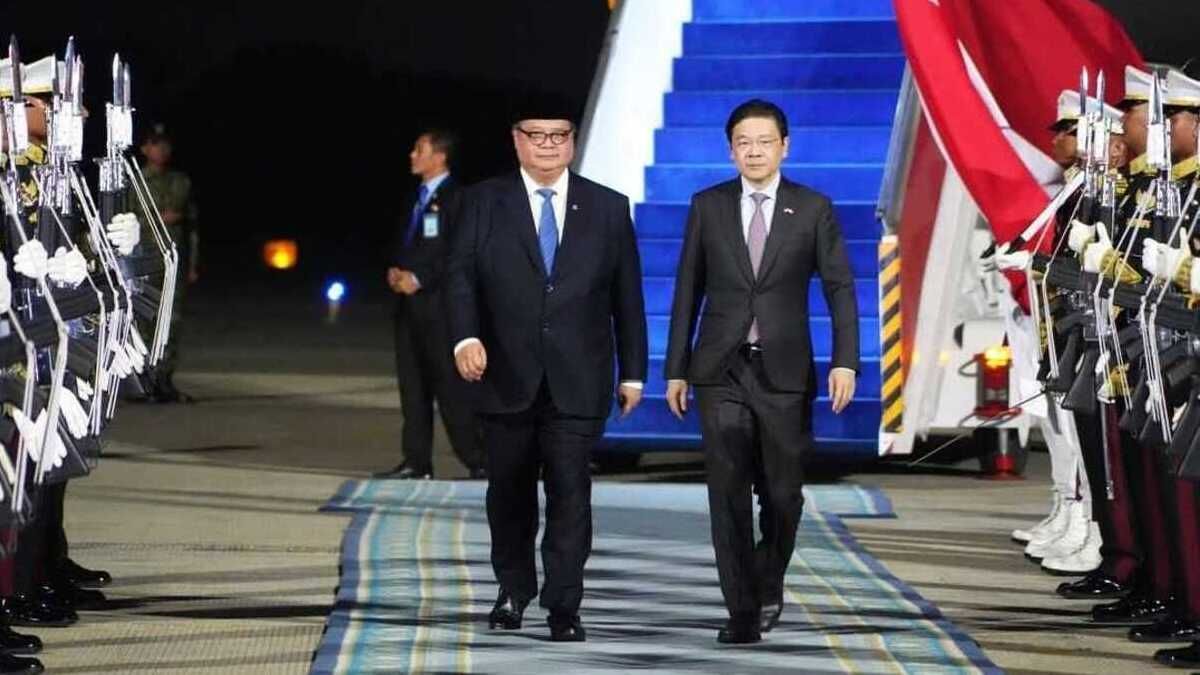
The meeting between Indonesian President Prabowo Subianto and Singapore Prime Minister Lawrence Wong on Monday highlighted the depth of the economic relationship between the two neighbouring countries, underscoring Singapore's dual role as both Indonesia's largest foreign investor and one of its most important trading partners.
Wong's visit to Jakarta forms part of the annual Indonesia–Singapore Leaders' Retreat, the highest-level bilateral forum between the two countries. The discussions are expected to cover a broad range of issues, including political co-operation, regional developments and economic collaboration, which has long been a central pillar of bilateral ties.
The latest economic data paint a complex picture of the relationship. While Singapore continues to be the largest source of foreign direct investment (FDI) into Indonesia, Indonesia also runs a substantial trade deficit with the city-state, largely driven by imports of fuel and industrial machinery.
Indonesia's trade deficit with Singapore widens
According to Indonesia's Ministry of Trade, the country recorded a trade deficit with Singapore during the first six months of 2026 despite declines in both exports and imports.
Between January and June, Indonesia exported goods worth US$5.07 billion to Singapore, a decline of 22.57 per cent compared with the same period last year. Imports from Singapore totalled US$8.90 billion, down 7.67 per cent year-on-year but still significantly exceeding export values.
As a result, Indonesia posted a trade deficit of US$3.83 billion with Singapore during the first half of the year. Based on an exchange rate of approximately Rp17,980 per US dollar, the deficit was equivalent to around Rp68.9 trillion (S$4.9 billion).
The deficit widened by 23.93 per cent compared with the corresponding period in 2025, indicating that Indonesia's import dependence on goods from Singapore remains substantial despite slower trade activity overall.
A major factor behind the imbalance is energy trade. Indonesia's imports from Singapore continue to be dominated by mineral fuels, which were valued at US$5.13 billion during the six-month period.
Indonesia's Minister of Energy and Mineral Resources, Bahlil Lahadalia, recently said that around 62 per cent of Indonesia's fuel imports originate from Singapore, while 35 per cent come from Malaysia and the remainder from other countries.
The reliance reflects Indonesia's continuing gap between domestic oil production and consumption. Indonesia's oil lifting stood at approximately 605,000 barrels per day in 2025, while national consumption reached between 1.5 million and 1.6 million barrels per day, necessitating large-scale imports to meet domestic demand.
Beyond energy products, Singapore is also an important supplier of industrial and manufacturing equipment to Indonesia.
Imports under HS Chapter 84, which covers machinery, boilers, mechanical appliances and related equipment, reached US$1.19 billion in the first half of the year, marking a 43.96 per cent increase from a year earlier.
Meanwhile, imports of electrical machinery and equipment under HS Chapter 85 totalled US$564 million, up 3.5 per cent year-on-year.
The figures underline Singapore's role not only as a fuel trading hub but also as a source of equipment used in Indonesia's industrial, infrastructure and manufacturing sectors.
Singapore remains Indonesia's largest foreign investor
While Indonesia continues to run a trade deficit with Singapore, the investment relationship tells a different story.
Data from Indonesia's Ministry of Investment and Downstream Industry, commonly known as BKPM, show Singapore remained Indonesia's largest foreign investor during the first quarter of 2026.
Realised investment from Singapore reached US$4.6 billion during the January–March period, equivalent to approximately Rp75.9 trillion based on the state budget exchange rate assumption of Rp16,500 per US dollar.
Singapore's investment inflows substantially exceeded those from other major economies. Hong Kong ranked second with US$2.7 billion, followed by China with US$2.2 billion, the United States with US$1.3 billion and Japan with around US$1 billion.
Singapore's investment was nearly 1.7 times larger than that of Hong Kong, highlighting its continued dominance as a source of capital entering Indonesia.
Overall, foreign direct investment contributed around Rp250 trillion during the first quarter of 2026, accounting for 50.1 per cent of Indonesia's total realised investment and representing annual growth of 8.5 per cent.
Why Singapore dominates investment flows
Economists have long noted that Singapore's position as Indonesia's leading foreign investor is closely linked to its status as one of Asia's foremost financial centres.
The city-state hosts a concentration of international banks, investment funds, venture capital firms, private equity companies and regional headquarters of multinational corporations. As a result, Singapore often serves as a conduit through which global capital is channelled into Southeast Asian markets.
Indonesia remains one of the region's most attractive destinations for that capital due to its large population, expanding consumer market, extensive infrastructure needs and long-term growth potential.
Consequently, a significant portion of investments recorded as originating from Singapore may ultimately represent capital from multinational firms and global investors that use Singapore as their regional base.
This role has further strengthened Singapore's importance in Indonesia's economic development, particularly in sectors such as manufacturing, digital technology, infrastructure, logistics and renewable energy.
Singapore's economy continues to expand
Singapore's importance to Indonesia is also supported by its own strong economic performance.
According to official Singapore government data, the republic's economy grew by 6.0 per cent year-on-year in the first quarter of 2026, significantly exceeding the initial estimate of 4.6 per cent.
On a quarter-on-quarter basis, gross domestic product expanded by 1.0 per cent, reversing an earlier estimate that had suggested a contraction of 0.3 per cent.
The improvement was driven by stronger domestic activity and a recovery in external demand, although authorities have maintained a cautious outlook amid continued uncertainty in the global economy.
Singapore's Ministry of Trade and Industry has retained its full-year growth forecast of between 2.0 per cent and 4.0 per cent for 2026.
Inflation has also remained relatively subdued. Consumer prices rose 1.8 per cent in May, unchanged from April and below market expectations.
The country's economic resilience has helped support the Singapore dollar, which has remained near its strongest levels against the Indonesian rupiah in the past year.
According to Bloomberg data, the Singapore dollar was trading at around Rp13,918 on Monday, close to the upper end of its 52-week range of Rp12,565 to Rp14,129.
Leaders' retreat expected to deepen co-operation
Against this backdrop, the Leaders' Retreat is expected to reinforce the already extensive economic relationship between the two countries.
Officials have indicated that as many as 26 memoranda of understanding are expected to be signed during the visit, covering a range of strategic sectors and areas of bilateral co-operation.
For Indonesia, Singapore remains a crucial source of capital, financing and access to international investors. For Singapore, Indonesia represents a major market, investment destination and economic partner within Southeast Asia.
The latest figures suggest that while trade flows continue to favour Singapore, investment ties remain increasingly important to Indonesia's economic ambitions, making the relationship one of the most significant bilateral economic partnerships in the region.