Four migrant worker advocacy groups urge sweeping Employment Act reforms to strengthen worker protections
Four labour advocacy groups have proposed sweeping amendments to Singapore's Employment Act, calling for stronger protections for migrant and lower-wage workers, expanded wage recovery mechanisms, improved enforcement, and a pathway towards a universal minimum wage framework.
- Four advocacy groups submitted proposed Employment Act amendments to strengthen protections for migrant and lower-wage workers.
- The proposals include a 40-hour work week, stronger wage enforcement and expanded worker entitlements.
- The groups also urged Singapore to establish wage protection mechanisms and work towards a universal minimum wage.

A coalition of four labour advocacy organisations has called for sweeping amendments to Singapore’s Employment Act (EA), arguing that the country’s labour protections no longer adequately reflect modern employment realities, particularly for migrant and lower-wage workers.
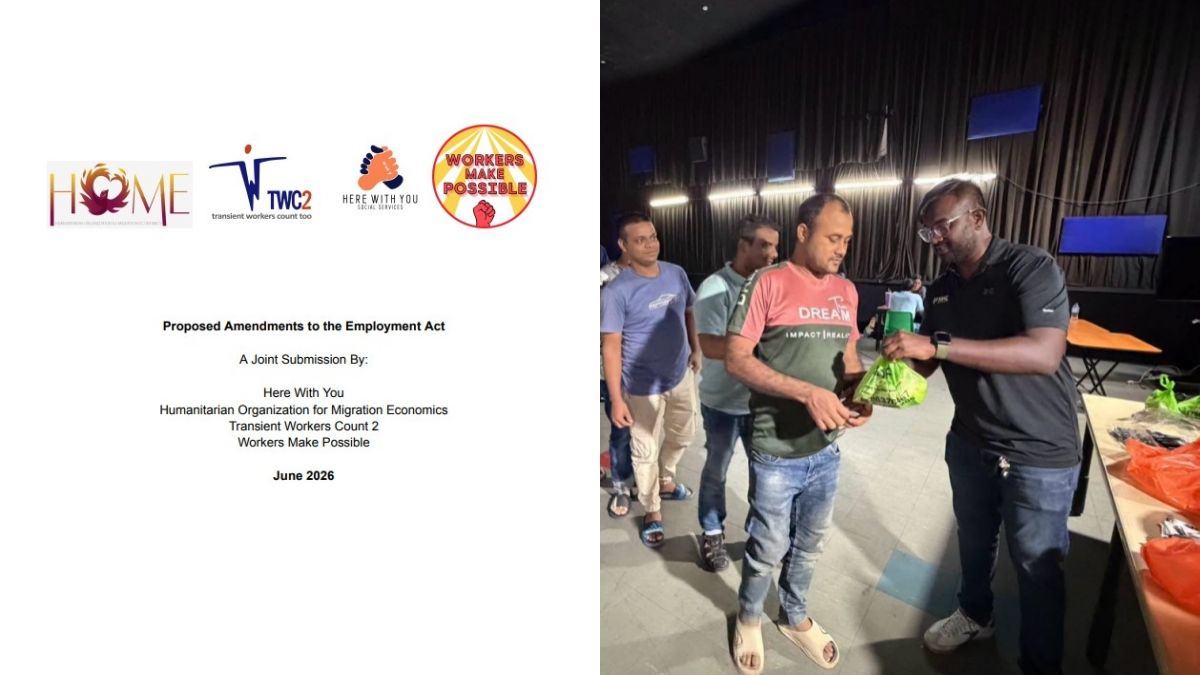
The Proposed Amendments to the Employment Act, jointly submitted by four migrant workers groups in Singapore,Here With You, Humanitarian Organization for Migration Economics (HOME), Transient Workers Count 2 (TWC2), and Workers Make Possible.
The groups have four key objectives:
• Improve worker wellbeing
• Close protection gaps that
disproportionately affect vulnerable groups
• Strengthen enforcement mechanisms to promote greater transparency and accountability in regulatory action
•Align Singapore's labour standards with contemporary expectations of decent work
Together, the group call for urgent reforms to the Employment Act during this review period.
We know the importance of fair standards in our own workplaces.
But we need to make it a reality for all workers in Singapore.
MOM alongside NTUC and SNEF, is conducting a major review of the Employment Act. In August 2025, the Ministry of Manpower (MOM) announced a comprehensive review of the Employment Act. This Act is the Employment Act 1968.
MOM will publish the Employment Act review findings in the second half of 2026.
HOME in a 2 July social media post, noted that
Addressing the unfair treatment of workers requires change in the policies that enable it.
Unpaid salaries are just one of the many challenges faced by migrant workers. Our current system leaves them vulnerable to multiple, overlapping issues, including overwork, deception and unfair dismissal.
Even if workers are able to come forward, they usually do so individually or in smaller groups, so they often do not receive enough visibility to spur intervention.
Intervention should not just be ad hoc emergency assistance. Protection should not depend on hundreds of workers turning up at MOM, or a case becoming visible enough to generate public urgency.
Singapore cannot rely on reactive responses that only happen after damage is done. We must do more to protect workers so that they are not vulnerable to exploitation in the first place.
Cases of unfair treatment should be a wake up call for broader, stronger worker protections and justice mechanisms.
What does reform look like?
HOME said Interpretation
The Employment Act is Singapore's primary labour law. It prescribes the basic terms and working conditions for all kinds of employees, including workers who are part-time, contract or temporary.
For almost 60 years, it has been the legal foundation of the rights and obligations of employers and employees. The Act covers key matters concerning workers' protections, including minimum terms of employment, salary payment, hours of work, rest days and leave entitlements.
HOME said Changes to the
Employment Act have the potential to recalibrate rights and obligations across the labour market.
For lower-wage resident and migrant workers, the Act is especially crucial - they are often most vulnerable to labour exploitation, and thus dependent on its safeguards.
The organisations framed the proposals as targeted reforms aimed at strengthening legal safeguards, improving wage transparency, and addressing what they described as “long-standing structural gaps” disproportionately affecting vulnerable workers.
According to the report, the recommendations were largely informed by the groups’ direct casework experiences with migrant workers in Singapore.
The report stated that amendments to the Employment Act carry “system-wide consequences” because they affect “the balance of rights and obligations across the labour market”, particularly for migrant workers whose work permits remain tied to employers.
The groups wrote that the proposed reforms sought “to reinforce the EA’s foundational purpose: to provide meaningful, accessible, and enforceable minimum standards that uphold dignity, fairness, and security in the workplace for all workers in Singapore”.
Central to the submission was a proposal to reduce Singapore’s statutory maximum working week from 44 hours to 40 hours.
The organisations argued that the current 44-hour threshold under Part IV of the Employment Act was “increasingly out of step with domestic labour norms”.
They noted that Singapore’s civil service shifted to a five-day work week in 2004 to promote “a better work life balance”, while many professionals and white-collar workers already operate under five-day arrangements through contractual practice.
By contrast, lower-wage employees and manual labourers often continue working five-and-a-half-day weeks.
The report argued that this effectively “reinstat[ed] discrimination between white-collar and blue-collar employees that was once removed in 1968”.
The groups also linked the proposed 40-hour threshold to wage transparency.
“A 40-hour cap aligns seamlessly with Singapore’s standard 5-day workweek and typical 8-hour workday, eliminating the current ‘mismatch’ in which OT is triggered only after 44 hours of work,” the report stated.
The organisations said the current overtime structure frequently generated payroll disputes among low-wage workers who relied heavily on overtime income.
The submission also proposed standardising pay rates for employees working on rest days.
Under the existing framework, workers receive two days’ salary if the employer requests work on a rest day, but only one day’s salary if the work is deemed employee-requested.
The groups argued that this distinction was outdated and failed to reflect actual power dynamics between employers and workers.
“The distinction between ‘employer-requested’ and ‘employee-requested’ work is often a legal fiction that ignores the inherent power imbalance in employment relationships,” the report said.
The organisations argued that migrant workers tied to specific employers through work permit conditions may feel pressured to “volunteer” for additional work despite lacking meaningful freedom to refuse.
Another major focus of the report concerned wage documentation and enforcement.
The groups called for increased penalties against employers who fail to issue itemised payslips, Key Employment Terms (KETs), and employment records.
While such documentation became mandatory in 2016, the report argued that existing penalties — which can be as low as S$100 — were insufficient deterrents.
The submission cited 2024 data showing that one in 10 Work Permit holders did not receive itemised payslips, while one in six received them inconsistently.
The report stated that workers without documentation often struggle to substantiate wage theft allegations.
“Without KETs or payslips, they lack the primary evidence required to substantiate wage theft claims,” the organisations wrote.
The groups also proposed requiring employers to deposit salaries directly into workers’ bank accounts whenever employees request it.
According to the report, electronic salary payments would create clearer records in situations involving disputed wages, undocumented deductions, or allegations that workers signed blank payslips upon arrival in Singapore.
The organisations argued that existing provisions under the Employment of Foreign Manpower Act (EFMA) regulations should instead be formally incorporated into the Employment Act itself.
“This emphasizes the gravity of providing accurate salary payment records,” the report stated.
The submission further called for stronger protections concerning annual leave and sick leave.
The groups proposed increasing the statutory minimum annual leave entitlement from seven days to 14 days annually.
The report described seven days of leave as insufficient “by modern standards” and argued that physically demanding sectors such as construction, marine work, and domestic services exposed migrant workers to heightened risks of fatigue and burnout.
“Additional leave would allow them to better manage their physical and mental health,” the report stated.
The organisations also proposed removing the current three-month waiting period before employees become eligible for paid sick leave.
According to the report, denying sick leave during the initial months of employment forces workers to choose “between health and income”.
The groups argued that the issue was especially serious in high-risk industries where workers operating while ill could face increased risks of workplace accidents.
“Fatigue, lethargy and lack of concentration may increase the risk of serious or even fatal injuries,” the report stated.
The report additionally sought reforms to annual leave encashment rules.
Currently, employees dismissed for reasons other than misconduct are entitled to payment for unused annual leave, but employees who resign are generally excluded.
The organisations argued this distinction created ambiguity and unnecessary disputes, especially when employers reject leave requests during notice periods.
The report proposed extending leave encashment entitlements to workers who resign voluntarily.
The organisations also focused heavily on dispute resolution timelines and access to justice.
One proposal called for extending the deadline for wrongful dismissal claims from one month to three months.
The groups argued that dismissed employees often spend the immediate aftermath of termination searching for work or addressing financial hardship rather than pursuing legal action.
For migrant workers, the report said the problem was compounded by immigration restrictions.
“If an employer denies a job transfer, these workers must leave the country almost immediately,” the report noted.
The organisations cited MOM statistics indicating that foreign employees file four times as many salary claims as locals, but only half as many wrongful dismissal claims.
The submission also proposed extending the Employment Claims Tribunal (ECT) salary claim period from one year to two years.
According to the report, wage discrepancies often accumulate gradually, especially in industries dependent on migrant labour.
Workers may delay reporting problems because they fear retaliation, repatriation, or blacklisting.
The groups argued that extending claim windows would reduce incentives for employers to delay disputes until statutory deadlines expired.
“Workers may hesitate to report problems immediately because they fear retaliation, repatriation, or blacklisting,” the report stated.
The organisations further called for extending the deadline for post-employment salary-related disputes from six months to 12 months.
The report argued that migrant workers frequently require additional time after leaving employment to obtain records, seek legal advice, and understand whether underpayment occurred.
Another proposal targeted the ECT’s salary claim caps.
Currently, union-assisted workers may claim up to S$30,000, while non-unionised workers are limited to S$20,000.
The groups argued that this created unequal access to justice because many vulnerable workers, including migrant labourers and platform workers, are not union members.
“Access to statutory dispute resolution should not depend on union membership status,” the report stated.
The organisations proposed raising the annual claim limit to S$30,000 for all workers and increasing the total claimable amount to S$60,000.
The submission also addressed enforcement shortcomings following tribunal decisions and mediated settlements.
The report argued that favourable ECT orders often fail to translate into actual payment for workers because enforcement burdens remain largely private.
The groups proposed “more proactive prosecutions”, stronger penalties, faster recovery mechanisms, and compensation systems for unpaid judgments.
They additionally recommended barring directors of companies with unpaid salary liabilities from registering new businesses.
The report also devoted significant attention to employer insolvency.
The organisations proposed either a statutory wage protection fund or mandatory wage recovery insurance to compensate workers when companies collapse.
The groups argued that existing support schemes remained fragmented and insufficient.
The report referenced parliamentary questions raised in January 2026 by Members of Parliament He Ting Ru and Gerald Giam concerning financial support for workers affected by corporate liquidations.
According to the submission, current support mechanisms leave many workers dependent on discretionary assistance schemes.
“No worker should be denied their owed wages regardless of their income or nationality,” the report stated.
The organisations argued that wage recovery insurance was “direly needed” to protect workers during insolvencies and bankruptcies.
The report also called for formally recognising migrant domestic workers (MDWs) under the Employment Act.
Currently, domestic workers are excluded from the EA and regulated separately under the Employment of Foreign Manpower Act.
The organisations argued that MDWs lack many baseline labour protections available to other workers, including overtime limits, annual leave entitlements, and resignation rights.
The report described the issue as increasingly urgent given Singapore’s growing dependence on migrant domestic workers for eldercare in an ageing society.
“Without clear limits on working hours or accessible exit options, MDWs may be expected to remain constantly on call,” the report warned.
The submission concluded with a proposal for Singapore to work towards establishing a universal minimum or living wage covering all workers, including migrants.
The groups suggested extending the Local Qualifying Salary framework and Progressive Wage Model protections to migrant workers.
The report noted that some migrant workers continue earning salaries “as low as S$400 per month”.
The organisations argued that a universal wage floor would reduce in-work poverty and prevent labour standards from being undermined through differential treatment of migrant workers.
The groups concluded that the proposed reforms would help Singapore “reinforce its commitment to fair employment, social cohesion, and sustainable economic growth”.
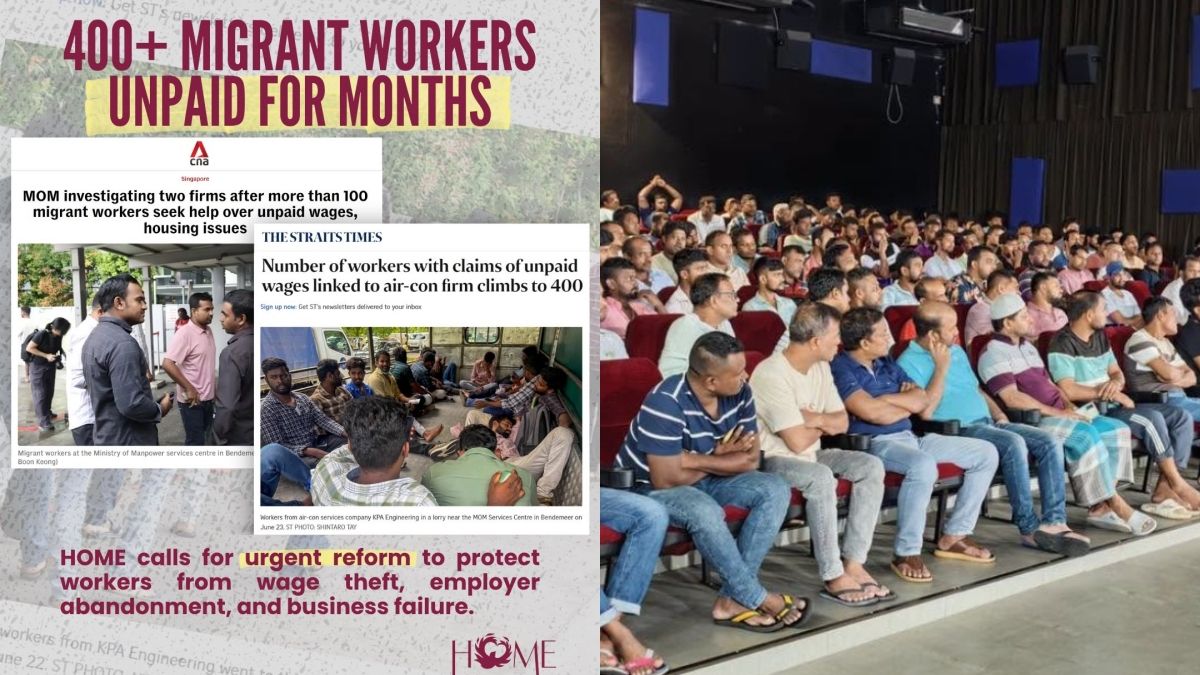
The proposals come amid Wage disputes involving more than 400 migrant workers across three related companies have intensified scrutiny of Singapore’s wage recovery system, the cases involving KPA Engineering, SK Industries and VVR Plant Engineering
The wage dispute first came to public attention on 22 June 2026, when more than 100 migrant workers presented themselves at the Ministry of Manpower (MOM) service centre in Bendemeer reporting unpaid salaries.
The number of affected workers subsequently rose to approximately 400 across the three companies, all linked to a common director, Ramu Palani Velu, an Indian national and Singapore permanent resident.
He returned to Singapore and surrendered his passport to authorities on 28 June, and is assisting with investigations, according to Minister of State for Manpower Dinesh Vasu Dash.