
HOME seeks public support for complete ban on migrant worker lorry transport in Singapore
Migrant workers’ rights group HOME has launched a petition urging Singapore to permanently ban the transport of workers on lorries, arguing that existing safety measures do not address long-standing risks faced by migrant workers.
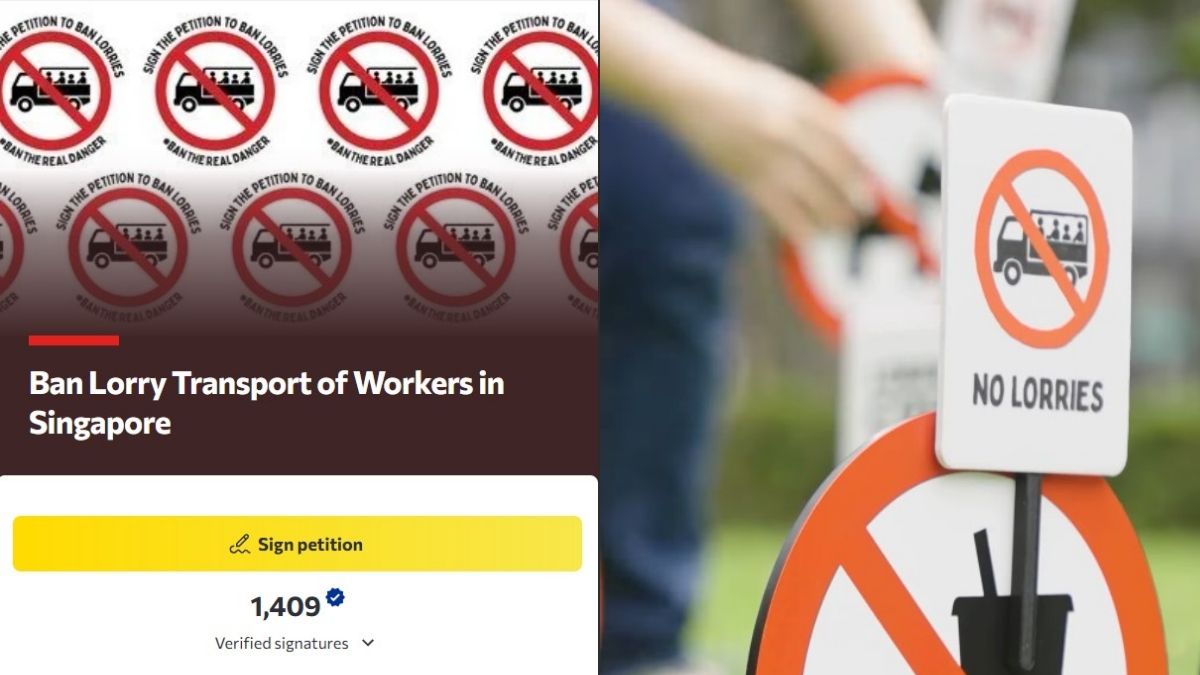
- HOME petition urges Singapore to completely ban migrant worker transport on lorries and remove existing legal exceptions.
- The group argues current measures, including the 2027 caged lorry ban, do not address wider safety risks.
- Advocacy groups call for safer transport alternatives supported through government assistance and enforcement.

SINGAPORE: The Humanitarian Organisation for Migration Economics (HOME) has launched a petition urging the Singapore government to completely ban the transport of migrant workers on lorries, arguing that the current system continues to expose workers to unacceptable safety risks.
The petition calls for the removal of an exception under the Road Traffic Act that allows employees to be transported on lorries owned by their employers.
As of 30 June 2026, 3pm, the petition hosted on Change.org had collected 1,410 signatures.
HOME said Singapore’s existing approach does not go far enough and urged authorities to establish a clear timeline for businesses to transition towards safer forms of worker transport.
The organisation also called for support for employers, particularly small and medium-sized enterprises (SMEs), through the use of foreign worker levy revenue to assist with the transition.
The petition further called for stronger enforcement of existing transport safety measures.
Advocacy groups urge immediate action
In a social media post, HOME said Singapore had introduced bans on various activities, including skateboarding, feeding birds and the consumption of durians in certain locations.
The organisation argued that lorry transport of migrant workers remained permitted despite the risks associated with the practice.
HOME said lorry transport injures an average of 334 migrant workers annually and has resulted in more than 114 deaths since 2000.
“So we decided to make a stand,” HOME said in its campaign message.
The organisation created a campaign using redesigned versions of iconic Singapore prohibition signs, turning them into symbols calling for a ban on lorry transport.
“Introducing ban the real danger. We turned the iconic signs for banned things in Singapore into a movement of unlikely protesters,” HOME said.
The campaign was presented during Singapore’s Labour Day rally, where workers’ rights issues were highlighted.
HOME said each picket sign represented a petition calling for a ban on lorry transport, which it described as a greater danger than the activities commonly associated with Singapore’s well-known restrictions.
The organisation said the campaign attracted attention and encouraged hundreds of Singaporeans to sign the petition.
With support continuing to grow, HOME called for more members of the public to support the petition.
Advocacy groups call for safer worker transport
HOME said thousands of migrant workers in Singapore continue to be transported daily on the back of lorries, vehicles designed primarily for carrying goods rather than passengers.
The organisation described the practice as unsafe and undignified, saying migrant workers should receive the same basic safety standards expected by others.
“Migrant workers build our homes, roads, and city. They deserve the same basic standards of safety and dignity that everyone else expects,” the petition stated.
HOME argued that existing measures do not fully address the problem.
The organisation said the planned ban on “caged lorries” from 2027 would not resolve the broader issue because workers could still be transported on open lorries, which it described as inherently unsafe.
“Lorry transport is not unavoidable. It is a choice — and it can be changed,” HOME said.
In 2025, HOME published its Risky Rides report, which examined worker transport conditions and proposed solutions.
The organisation said safer alternatives already existed, including buses and vehicles equipped with proper seating and seatbelts.
HOME also pointed to foreign worker levy revenue collected by the government, stating that S$7.14 billion was collected in 2025, and argued that these funds could be used to help employers make the transition.
“No one should risk their life just to get to work,” HOME said.
Long-standing safety concerns
The campaign follows earlier calls from civil society organisations to end the use of lorries for transporting workers.
In 2023, more than 50 community organisations signed a joint statement opposing the continued use of lorries to ferry workers.
The groups argued that lorries were not designed to carry human passengers and exposed workers to risks including serious injuries from traffic accidents, heat stress and heavy rain.
They called for safer transport arrangements that prioritised worker safety and dignity.
Singapore to ban caged lorries from 2027
The Singapore government announced in March 2026 that it would ban the ferrying of workers in caged lorries from 1 January 2027.
Senior Minister of State for Transport Sun Xueling announced the move during the Committee of Supply debate for the Ministry of Transport.
Sun said the government had been working with industry representatives and non-governmental organisations to improve worker transport safety.
“We have made good progress introducing requirements for lorries ferrying workers to be fitted with canopies and higher protective side railings, have lower speed limits and to meet minimum space requirements,” she said.
She added that, following consultation with tripartite partners, the ministry would “take a further step”.
Advocates say caged lorry ban leaves most workers' transport risks unaddressed
However, HOME executive director Stephanie Chok said the planned ban represented only limited progress.
Chok described the move as “a small step in the right direction in signalling that migrant workers deserve dignified transport”.
She cautioned that lorries would remain unsafe even without cages.
Chok said caged lorries represented only 1 to 2 per cent of the approximately 50,000 lorries in Singapore.
“As such, this measure will affect only a small fraction of workers, who will still continue to be transported on the back of lorries and exposed to the same risks as before,” she said.
Calls to phase out goods vehicles for worker transport
Ethan Guo, executive director of migrant workers’ rights organisation Transient Workers Count Too (TWC2), said the long-term goal should be to remove goods vehicles from worker transport entirely.
Guo said passenger buses should replace lorries as the preferred method of transporting workers.
“There will be costs involved in doing the right thing, yes, but in return, the workers arrive at work in peace and consequently perform better in their jobs the rest of the day,” he said.
“This isn't something that should be viewed through the lens of profit and loss, but the value of a human life,” he added.