KPA Engineering case exposes wage recovery gaps; HOME calls for statutory wage protection fund reform
HOME says disputes involving over 400 migrant workers reveal wage theft risks and systemic failure in recovery mechanisms, calling for statutory wage protection fund or mandatory insurance.
- HOME says wage disputes involving over 400 workers expose systemic wage recovery failures in Singapore.
- Advocacy groups call for statutory wage protection fund or mandatory insurance to secure unpaid salaries.
- Even with legal rulings, workers often cannot recover wages due to insolvency or untraceable employers.

SINGAPORE: Wage disputes involving more than 400 migrant workers across three related companies have intensified scrutiny of Singapore’s wage recovery system, with advocacy groups warning that structural gaps continue to leave low-wage foreign workers vulnerable to unpaid salaries.
The Humanitarian Organisation for Migration Economics (HOME) said the cases involving KPA Engineering, SK Industries and VVR Plant Engineering expose long-standing weaknesses in enforcement and compensation mechanisms, particularly for workers whose immigration status is tied to their employers.
The organisation stated that the situation reflects broader systemic risks in which legally owed wages often remain unrecovered even after formal dispute resolution processes are completed.
Wage disputes highlight systemic vulnerabilities
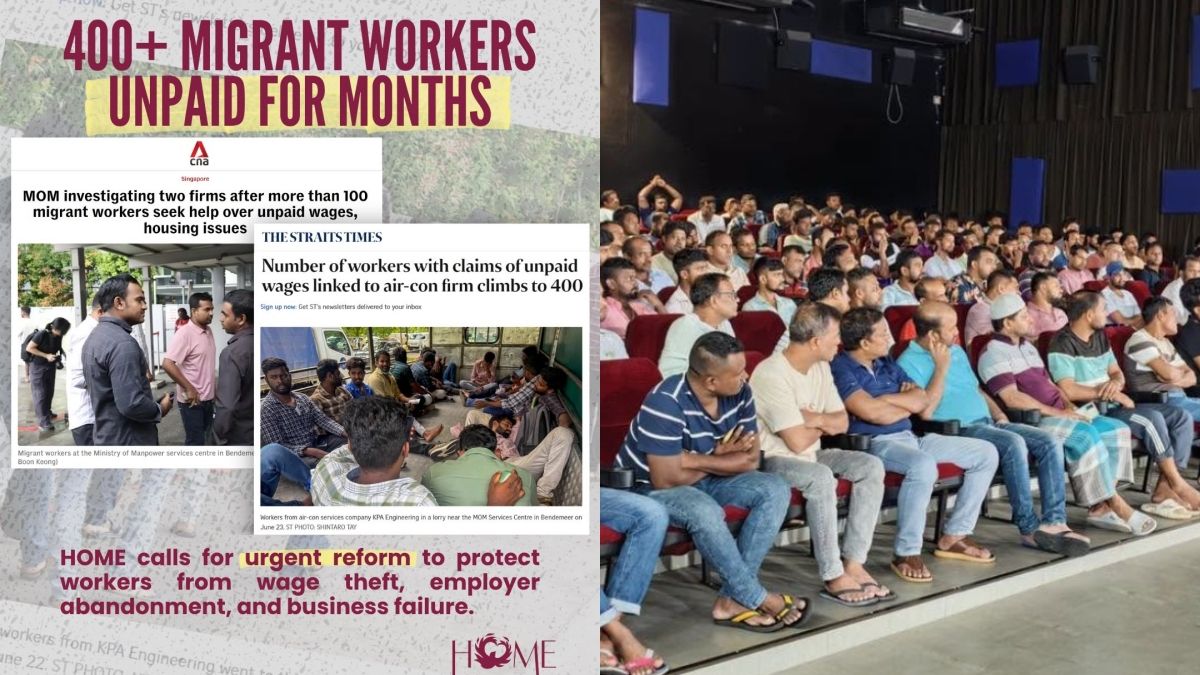
The wage dispute first came to public attention on 22 June 2026, when more than 100 migrant workers presented themselves at the Ministry of Manpower (MOM) service centre in Bendemeer reporting unpaid salaries.
The number of affected workers subsequently rose to approximately 400 across the three companies, all linked to a common director, Ramu Palani Velu, an Indian national and Singapore permanent resident.
He returned to Singapore and surrendered his passport to authorities on 28 June, and is assisting with investigations, according to Minister of State for Manpower Dinesh Vasu Dash.
HOME said the case reflects a recurring pattern in which workers only receive attention once disputes escalate significantly.
The organisation stressed that “non-payment of salaries is wage theft, and must be treated as such,” in a statement issued on Monday (30 June).
Wage recovery remains difficult even after formal claims
HOME said its casework shows that migrant workers frequently delay reporting salary issues due to fear of retaliation, including job loss, repatriation, or being blacklisted from future employment.
Many workers, it said, remain dependent on employer assurances that payment will be made, while others struggle with language barriers, lack of documentation, or limited understanding of formal claims procedures.
Even when workers pursue claims through the Tripartite Alliance for Dispute Management (TADM) or the Employment Claims Tribunals (ECT), HOME noted that enforcement remains a major obstacle.
The organisation said that if employers shut down, move assets, become uncontactable or lack funds, a favourable ruling may effectively become a “paper judgment.”
It added that discretionary assistance funds exist but are often insufficient to cover full outstanding wages, leaving workers partially or entirely uncompensated.
In cases where employers enter bankruptcy or liquidation, HOME said wage recovery can become even more delayed and uncertain, as workers must wait for lengthy insolvency proceedings before any potential payout.
“For workers whose employers have gone bankrupt or are undergoing liquidation, wage recovery becomes even more out of reach,” HOME said. “Workers may have to wait through lengthy liquidation proceedings before receiving their owed wages, if they receive them at all.”
Structural gap in enforcement and accountability
HOME warned that the current system allows situations where workers are legally entitled to wages yet remain unable to recover them in practice.
“A worker may be legally owed wages, and may even prove this through the formal claims process, but still struggle to recover the money. This is the central gap in the current system,” the organisation said.
It added that workers should not be made to bear the cost of business failure, and called for stronger accountability mechanisms for employers and company directors.
HOME urged urgent reform, stating: “We call for urgent reforms to prevent similar cases from recurring. Workers should not be left with empty promises after months of labour.”
The organisation said structural solutions are needed beyond case-by-case intervention.
Call for statutory wage protection fund or insurance
HOME proposed the creation of a statutory wage protection fund or mandatory wage protection insurance to ensure workers can still recover unpaid salaries when companies fail.
Under a statutory fund model, workers would be able to claim unpaid wages directly from a government-administered fund when employers become insolvent, shut down or abandon employees.
The fund would then seek to recover the money from employers, directors or liquidation processes at a later stage.
HOME said this would prevent workers from having to wait years for insolvency proceedings to conclude before receiving earned wages.
It also noted that Singapore collects more than S$7 billion annually through foreign worker levies, arguing that a portion of these funds could be allocated towards wage protection mechanisms.
An alternative model proposed is mandatory wage protection insurance, requiring employers to insure against insolvency-related wage defaults.
HOME cautioned, however, that employers must not transfer these costs onto workers through wage suppression, illegal deductions or recruitment-related charges.
It called for complementary protections such as stronger enforcement against illegal deductions and broader wage safeguards to prevent cost-shifting.
The organisation said these protections should apply equally to all workers regardless of nationality, stressing that “if the work has been done, wages must be paid.”
Job mobility and recruitment pressures
HOME also highlighted restrictions on job mobility as a key factor exacerbating worker vulnerability.
It said the current work pass system gives employers significant control over workers’ employment status, which can discourage reporting of unpaid wages.
Workers may fear repatriation or inability to secure new employment if they leave disputes unresolved, particularly given recruitment debts incurred before arriving in Singapore.
Although workers may change employers in certain circumstances, HOME noted that they often face short timeframes to secure new jobs and may incur additional agency fees.
It said these conditions can push workers further into debt and limit their ability to pursue wage claims effectively.
HOME called for workers in wage disputes to be allowed to transfer employers by giving clear notice, without requiring employer consent, particularly when employers are in breach of obligations such as non-payment of wages.
The organisation also urged the creation of a streamlined job-matching system linking affected workers directly with willing employers.
It noted that unions and MOM had previously coordinated over 150 job opportunities for affected workers in the current case, and said such mechanisms should be institutionalised rather than handled on an ad hoc basis.
TWC2: MOM alerted to KPA Engineering wage issues prior to early 2026
Another migrant worker advocacy group, Transient Workers Count Too (TWC2), said early signs of wage irregularities involving KPA Engineering had been identified prior to the escalation of the dispute.
TWC2 Vice-President Alex Au said the pattern indicated systemic issues in the employer’s wage practices.
He also questioned the timing of regulatory intervention, asking, “Why did it take 100 workers approaching the MOM for serious action to be taken?”
TWC2 said reliance on emergency interventions and charitable assistance is not sustainable and called for more structured wage protection mechanisms.
The organisation has proposed a salary insurance scheme requiring employers to purchase coverage that guarantees workers’ wages in cases of insolvency or non-compliance.
Under its proposal, insurers would pay outstanding salaries, while disputes over amounts would be resolved through formal tribunals.
TWC2 said this would ensure workers continue receiving wages even when employers become uncontactable or refuse to comply with rulings, reducing reliance on discretionary support systems.