Taiwan targets 100,000 drone units a month by 2030 as exports set to double
Taiwan's drone industry produced NT$12.9 billion in output last year and is on track to reach monthly production of 100,000 units by 2030, with exports projected to rise from 20 to 50 percent of total output, officials say.
- Taiwan's drone output rose 2.5-fold in 2025 to NT$12.9 billion, exceeding earlier forecasts.
- Monthly production capacity is targeted to grow from 15,000 units to 100,000 by 2030.
- Q1 2026 drone exports already surpassed the total export value recorded for all of 2025.

Taiwan is targeting a sevenfold increase in drone production capacity by 2030, with monthly output set to rise from 15,000 to 100,000 units, as the government looks to transform the sector from a domestically focused industry into a major export platform.
Chiou Chyou-huey, director-general of the Ministry of Economic Affairs' (MOEA) Industrial Development Administration, disclosed the targets at a media briefing in Taipei on 21 May 2026, citing strong momentum from the government's unmanned vehicle industry development programme.
Taiwan's drone output value grew 2.5-fold in 2025 to NT$12.9 billion (approximately US$408 million), up from NT$5 billion in 2024. Export revenues from finished drone products rose from NT$1.4 billion to NT$29.5 billion — a roughly 21-fold increase — according to figures presented by Chiou.
First-quarter 2026 exports have already surpassed the full-year 2025 total. Chiou said export revenue for the January-to-April period reached US$147 million, and forecast that full-year exports for 2026 could exceed NT$7.5 billion if the current pace is maintained.
He added that if the sector's output value doubles again this year to NT$26 billion, the government's original 2030 output target of NT$40 billion (approximately US$1.3 billion) would likely be revised upward.
Export destinations and the Ukraine war
Taiwan's three largest drone export markets are the Czech Republic, Poland and the United States. Chiou noted that demand from the Czech Republic and Poland may be connected to the ongoing war in Ukraine, saying Taiwan-made drones sold to Czech buyers could potentially be deployed in that conflict.
In the first four months of 2026, exports reached US$147 million. The MOEA has set a target of raising the export share of Taiwan's total drone output from roughly 20 percent to more than 50 percent by 2030.
Chiou characterised the current phase as one of building domestic capability before expanding internationally, saying the industry should first consolidate technical strength at home and then progressively reduce reliance on the domestic market.
Military-grade focus as a competitive strategy
Taiwan's drone sector remains oriented primarily toward military-commercial applications rather than consumer products, where Chinese manufacturers hold a decisive price advantage. Chiou said that for consumer-grade drones, Chinese producers benefit from large-scale manufacturing, and the price gap can be several times wider than Taiwan's equivalent products.
For military-grade commercial drones — where anti-jamming capability, autonomous flight and operational reliability are prioritised over cost — Chiou said the price differential between Taiwan and Chinese products could be narrowed to within twofold, making Taiwan competitive in this segment.
He urged domestic manufacturers to concentrate on higher value-added unmanned aerial vehicles (UAVs) that integrate Taiwan's strengths in semiconductors and artificial intelligence, rather than competing directly with lower-cost Chinese offerings in the commodity segment.
Supply chain development and chip investment
The MOEA has been funding the development of what officials describe as a programme covering communications chips, flight control chips and satellite navigation chips, as well as ground control and flight control software. Most components under the programme are expected to complete development by the end of 2026.
Chiou said the ministry has provided subsidies through the Industry Innovation Platform and related enterprise research schemes to build domestic capability across these components, with the goal of reducing dependence on imported parts such as motors, processors and communication systems.
Between 2023 and 2024, the MOEA approved 31 research and development subsidy cases through the Industry Innovation Platform, covering whole aircraft systems, flight guidance and control technology, communications, payload development and AI-based autonomous recognition. The ministry said these investments underpinned the sector's recent growth in both output and export performance.
Green UAS certification to be available in Taiwan from June
Taiwan's Industrial Technology Research Institute (ITRI) joined the American Association for Uncrewed Vehicle Systems International's (AUVSI) Green UAS programme in January, becoming the first overseas organisation recognised to conduct cybersecurity testing and technical evaluations for commercial drones under the scheme.
Chiou said that from June 2026, Taiwanese drone manufacturers will be able to apply for Green UAS certification domestically, shortening the approval timeline for accessing the United States market. Previously, manufacturers would need to go through a longer overseas certification process.
XPONENTIAL 2026 and the Detroit mission
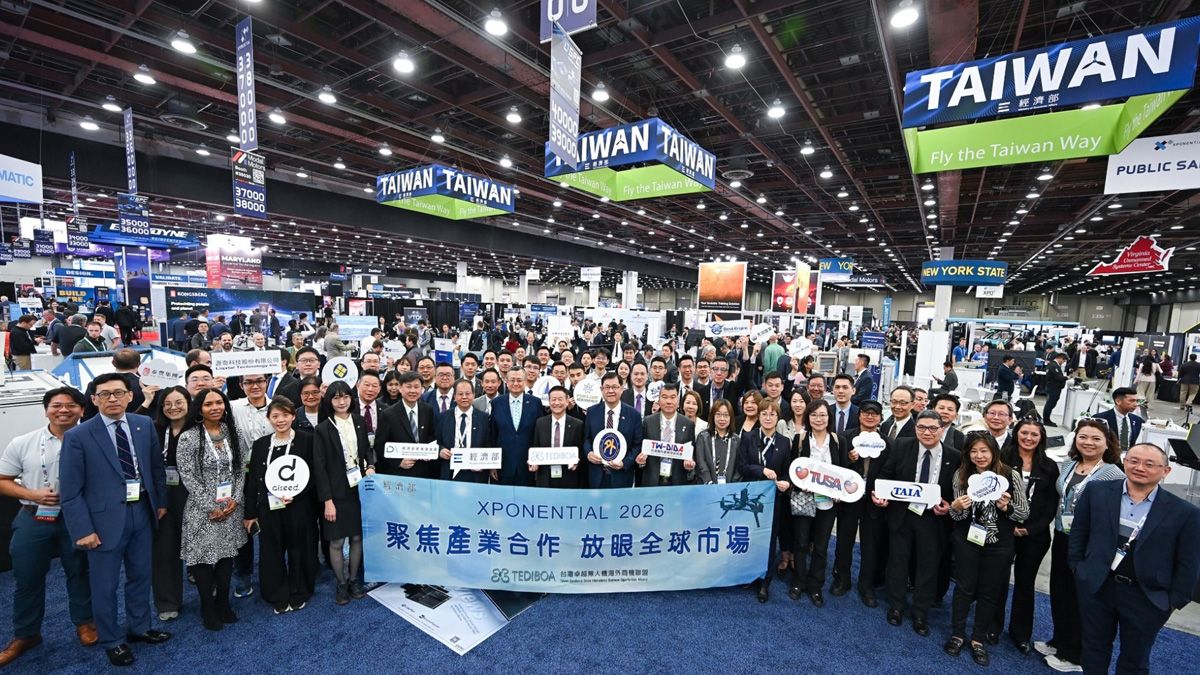
The MOEA, working with the Taiwan Excellence Drone Industry Business Opportunities Alliance (TEDIBOA), led a delegation of more than 130 industry, government and research representatives and 25 manufacturers to the XPONENTIAL 2026 unmanned systems exhibition in Detroit from 11 to 14 May 2026.
The delegation represented the largest Taiwan country pavilion in the event's history. Preliminary business opportunities generated at the exhibition were estimated at NT$1.3 billion, spanning optical modules, finished drone systems and thermal imaging components.
Companies from the United States, Europe, Japan, South Korea and Southeast Asia engaged in potential cooperation discussions with Taiwanese firms at the event.
Taiwan also signed memorandums of understanding (MoUs) with the Michigan Drone Association and the North Dakota Trade Office, covering autonomous flight, urban air mobility, edge computing and beyond visual line of sight flight testing, as well as access to shared testing and certification resources.
Thunder Tiger Technology became the first Asian drone manufacturer to receive Blue UAS certification from the United States Department of Defense, formally entering the American defence supply chain. Chiou described this development as a significant breakthrough for Taiwan's drone sector.
Subsidy duplication denied
The MOEA also addressed media reports alleging duplication between its own research subsidies and defence procurement funding.
The Industrial Development Administration said the two streams serve distinct functions: it funds development of technologies that have not yet reached commercial maturity, while the Ministry of National Defence maintains a separate procurement budget.
The ministry stated there was no overlap between the two.
Defense budget cuts and ministerial response
The development targets were disclosed against the backdrop of a significant reduction in Taiwan's defence spending.
Earlier in May 2026, the legislature passed a revised version of the government's eight-year NT$1.25 trillion defence special budget, approving a reduced allocation of NT$780 billion following opposition party amendments.
The cuts substantially reduced funding earmarked for domestic drone procurement and Taiwan-United States joint production projects.
In response, Chiou said the MOEA would continue to support local manufacturers in identifying and developing both domestic and overseas business opportunities, indicating the ministry did not intend to scale back its industry development programmes.
The MOEA said Taiwan would continue combining its strengths in information and communications technology, precision manufacturing and semiconductors to deepen cooperation with like-minded countries including the United States, Europe and Japan, with the stated goal of positioning Taiwan as a significant partner in what officials described as a global non-Chinese drone supply chain.