Military-linked accounts branded activists 'foreign agents' before acid attack, Amnesty report finds
Amnesty International has accused Indonesian authorities, including elements of the military and accounts linked to President Prabowo Subianto's Gerindra Party, of running coordinated online campaigns that brand journalists and activists as 'foreign agents', with some preceding physical violence.
- Amnesty links coordinated disinformation campaigns to accounts affiliated with Indonesian military units and President Prabowo's Gerindra Party.
- Online 'foreign agent' slurs preceded an acid attack on activist Andrie Yunus and intimidation of Tempo and Greenpeace.
- Meta, TikTok, X and YouTube faulted for letting posts spread; only TikTok responded to Amnesty's findings.

Amnesty International has accused Indonesian authorities, including elements of the military and social media accounts linked to the ruling Gerindra Party, of running coordinated online disinformation campaigns branding journalists and activists as 'foreign agents', with some episodes preceding physical violence.
The findings appear in 'Building up Imaginary Enemies', a 160-page report released this week. It documents an 18-month pattern under President Prabowo Subianto in which online smears against critics have repeatedly preceded intimidation and physical attacks.
Amnesty Secretary General Agnès Callamard said in an accompanying statement that online disinformation had emerged as 'a key tactic to systematically discredit government critics, shut down public debate and justify repression' since Prabowo took office in October 2024.
Amnesty researchers examined hundreds of posts across Instagram, Facebook, X, TikTok and YouTube, finding that campaigns disseminating 'foreign agent' allegations typically involved coordinated networks posting identical text, videos or graphics in quick succession.
Sources of the campaigns
The report identifies accounts appearing to be affiliated with military units and with Prabowo's Gerindra Party as central drivers of the campaigns. Neither the president's office nor the military immediately responded to media requests for comment.
In one case examined by Amnesty, a video labelling activists as foreign agents was first uploaded by three accounts owned by Gerindra Party offices before being amplified by 31 accounts affiliated with 27 military units across multiple platforms.
According to Amnesty's tally, Prabowo himself has invoked the role of 'foreign agents' at least 25 times in major speeches since taking office, including during last year's student-led protests. No supporting evidence has been made public.
Acid attack on KontraS activist
The most serious case documented is that of Andrie Yunus, deputy coordinator of the Commission for the Disappeared and Victims of Violence (KontraS), who suffered severe chemical burns in an acid attack in Jakarta in March 2026.
Yunus had spent months as the target of online campaigns portraying him as a foreign agent after he helped lead peaceful protests against revisions to Indonesia's Military Law. Four military officers were later arrested over the assault.
Even after the arrests, coordinated videos continued to circulate, this time accusing Yunus of staging the attack to attract foreign funding. One TikTok post published on 5 April 2026 claimed he 'secretly receives funds from American Jews'.
Tempo magazine and Greenpeace
Tempo, one of Indonesia's most respected investigative magazines, has been the target of sustained campaigns by accounts presenting themselves as military units, which accuse the outlet of being controlled by foreign donors after critical reporting on government policy.
Online smears have been accompanied by physical intimidation, including a severed pig's head delivered to the Tempo newsroom and follow-up packages containing decapitated rats. Subsequent disinformation portrayed those threats as staged stunts for foreign sympathy.
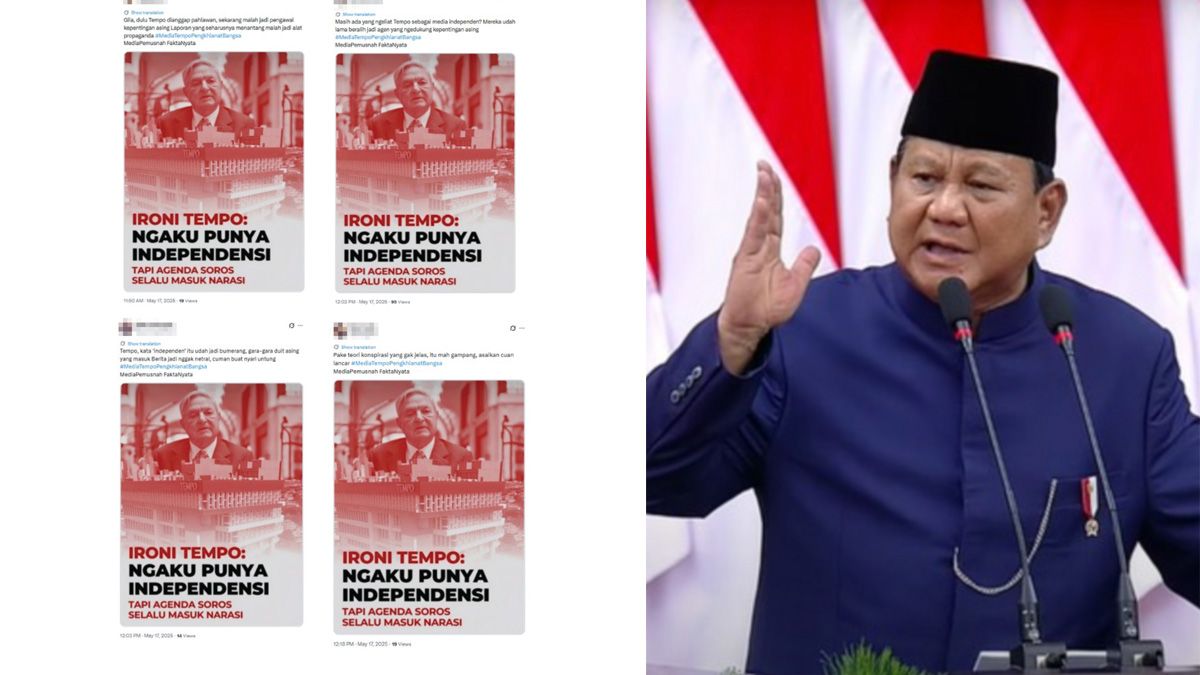
Amnesty documented identical X posts published within a single one-hour window on 17 May 2025, each featuring a graphic of US financier George Soros looming over the Tempo office under the headline 'The irony of Tempo'.
Greenpeace Indonesia campaigner Iqbal Damanik became another focus after leading protests against mining operations in Raja Ampat, West Papua. He told Amnesty he received anonymous death threats, including one warning that his 'head will fall to the ground'.
A tweet published on 7 June 2025 sought to link Damanik and Greenpeace to Papuan armed separatist groups, calling on the government to take 'firm action' against what it characterised as propaganda exploiting the Save Raja Ampat campaign.
Energy and Mineral Resources Minister Bahlil Lahadalia separately accused Greenpeace of acting on behalf of foreign interests following the Raja Ampat protests, a statement Amnesty says triggered further disinformation against the organisation.
Platforms criticised, only TikTok responds
The report faults Meta, TikTok, X and YouTube for inadequate content moderation and engagement-driven algorithms that allowed disinformation to spread rapidly. Most documented posts remained online for months, with some viral for more than a year.
Amnesty wrote twice to each of the four companies. Only TikTok replied, telling the organisation it would 'set up additional monitoring for this specific issue'. Meta, X and YouTube did not respond, according to the report.
'Big Tech's failures have contributed to the human rights harms documented in this report, with falsehoods spreading faster than facts,' Callamard said.
Legal landscape and outlook
Amnesty argues that Indonesia's domestic laws fail to protect those targeted by disinformation and are instead more often used against critics. A proposed law on 'Countering Disinformation and Foreign Propaganda' could further restrict freedom of expression, the organisation warns.
The report cites a journalist who told Amnesty that the climate of fear extended well beyond those directly targeted, discouraging people from joining protests, working with civil society or expressing critical views online.
Callamard called on Indonesian authorities to 'protect journalists, activists and protesters rather than enabling and disseminating toxic disinformation against them', and urged the four platforms to undertake Indonesia-specific human rights due diligence and provide remedies to those harmed.