Singapore survey finds more young residents staying single as family sizes shrink
Singapore's General Household Survey 2025 reveals rising singlehood among residents under 40, falling fertility, growing English use at home, and a larger share of residents with no religious affiliation.
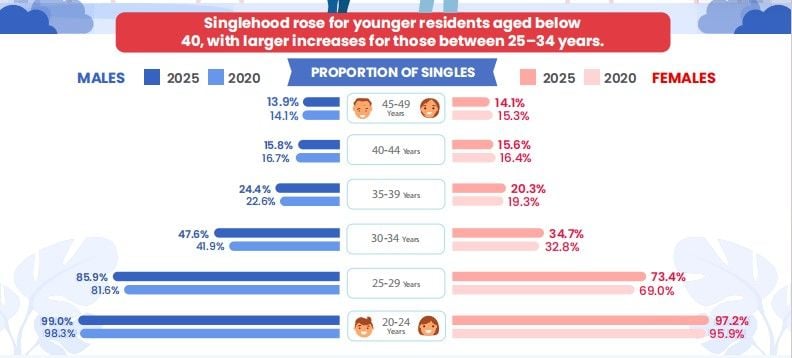
- Singlehood rose among residents below 40, with the sharpest increases among those aged 25 to 34.
- English is now spoken most at home by 58.1 per cent of residents, up from 48.3 per cent in 2020.
- The share of residents with no religious affiliation grew from 20 per cent to 23.9 per cent.

SINGAPORE: More young Singapore residents are staying single and having fewer children, while English has grown further entrenched as the dominant home language, according to the General Household Survey (GHS) released on 30 June 2026.
The mid-decade survey, conducted by the Department of Statistics (DOS) between the once-a-decade population census, also found that a rising proportion of residents now identify with no religion.
Singapore's resident population stood at 4.20 million in 2025.
A total of 27,324 households responded to the survey, achieving an overall response rate of 86.8 per cent.
Rising singlehood
The proportion of never-married residents rose across most age groups below 40.
Among female residents aged 25 to 29, the share who had never married increased from 69 per cent in 2020 to 73.4 per cent in 2025, the largest increase recorded among women.
Among men, the sharpest rise occurred in the 30 to 34 age group, where the proportion who had never married climbed from 41.9 per cent to 47.6 per cent.
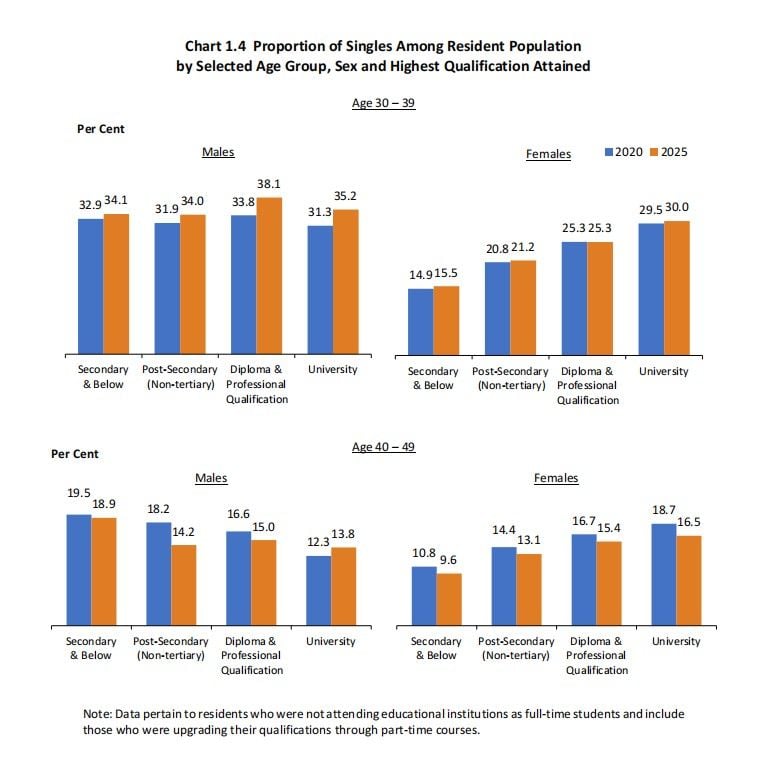
The survey identified diverging patterns by education.
Among men in their 40s, singlehood was more prevalent among those with lower educational qualifications.
Among women aged 30 to 49, those with higher qualifications were more likely to remain single.
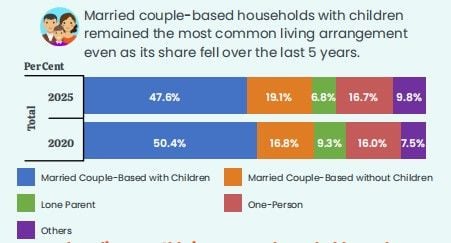
Despite these trends, married couple-based households with children remained the most common living arrangement, accounting for 47.6 per cent of resident households — down from 50.4 per cent in 2020.
The survey also recorded a sharp decline in the old-age support ratio, which fell from 4.3 to 3.3 — meaning there are now just 3.3 working-age residents for every person aged 65 and above, compared with 4.3 in 2020.
The proportion of residents aged 65 and above rose from 15.2 per cent to 18.8 per cent over the same period.
Among married couples, the share where both spouses were employed rose from 52.5 per cent in 2020 to 56.6 per cent in 2025, while the proportion with only the husband employed fell from 24.9 per cent to 21.0 per cent.
Fewer children
Female residents had fewer children on average compared with five years earlier.
Among ever-married women aged 40 to 49 — encompassing those currently married, widowed, divorced or separated — the average number of children born fell from 1.76 in 2020 to 1.67 in 2025.
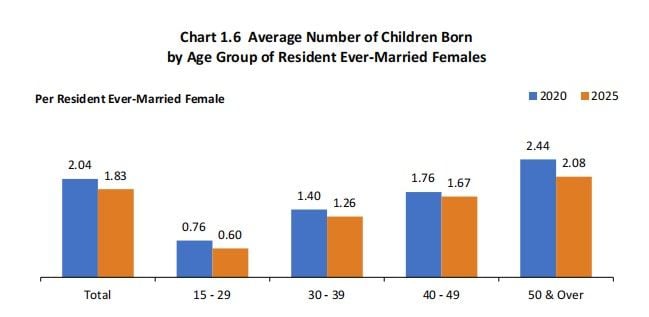
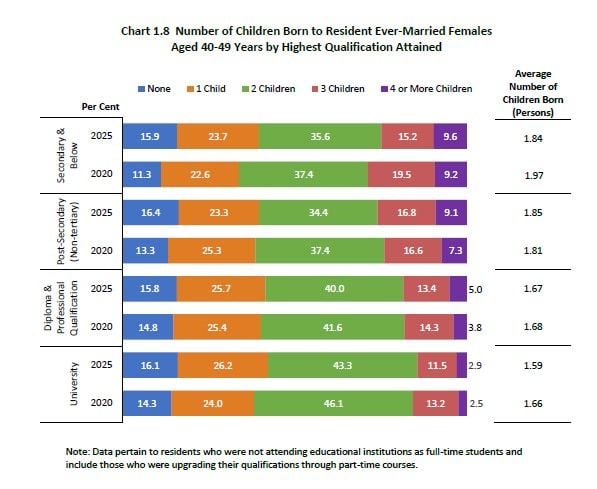
The proportion of women with two or more children also declined, from 62.5 per cent to 58.4 per cent, though a majority still had at least two children.
Higher education was associated with lower fertility.
Among ever-married women aged 40 to 49, university graduates had an average of 1.59 children in 2025, compared with 1.84 among women with secondary school qualifications or below.
English use grows
English consolidated its position as the language most frequently spoken at home.
Some 58.1 per cent of residents aged five and above used English most often at home in 2025, up from 48.3 per cent in 2020.
The use of English as the primary household language was more prevalent among younger residents than among older residents.
Among those who spoke English most at home, 80.5 per cent also used a vernacular language as their second most frequently spoken language, reflecting bilingual usage in daily life, according to the GHS report.
The use of Chinese dialects as the primary home language almost halved, falling from 8.7 per cent in 2020 to 4.9 per cent in 2025.
Mandarin use also declined, from 29.9 per cent to 26.6 per cent.
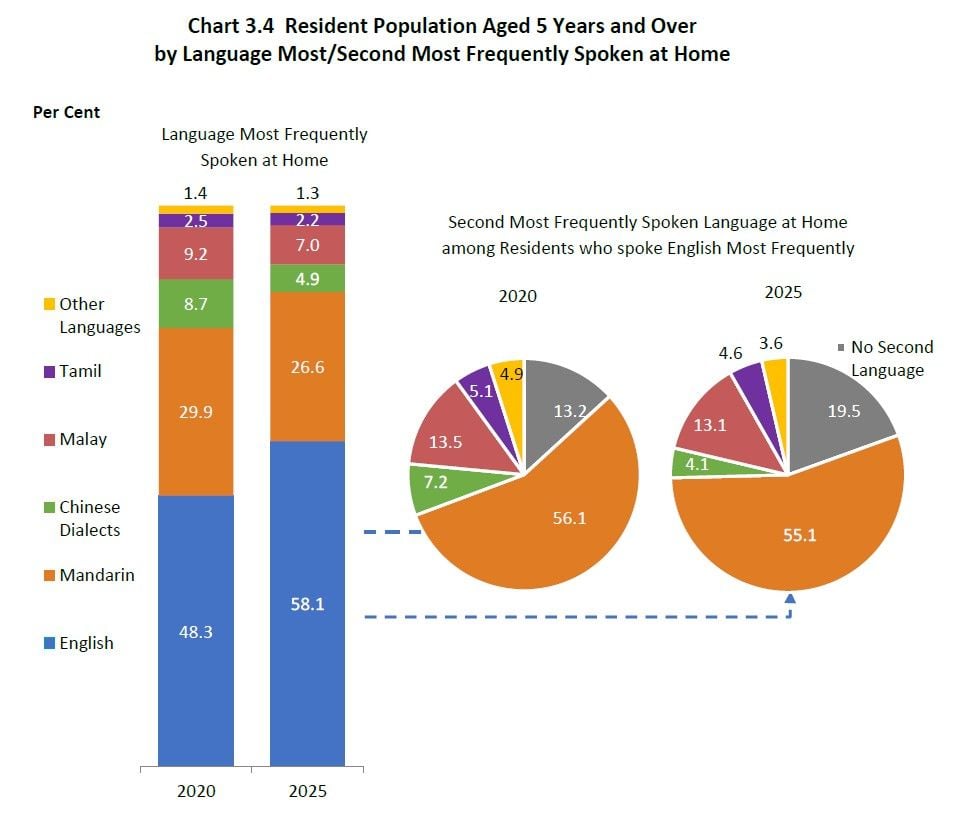
Among English-speaking residents, those who used Chinese dialects as a second language fell from 7.2 per cent to 4.1 per cent.
The proportion of residents who spoke English without any second language rose from 13.2 per cent to 19.5 per cent.
Fewer religious affiliations
A larger share of residents aged 15 and above reported no religious affiliation — 23.9 per cent in 2025, up from 20 per cent in 2020.
The increase was most pronounced among Chinese residents, where the proportion rose from 25.7 per cent to 30.3 per cent.
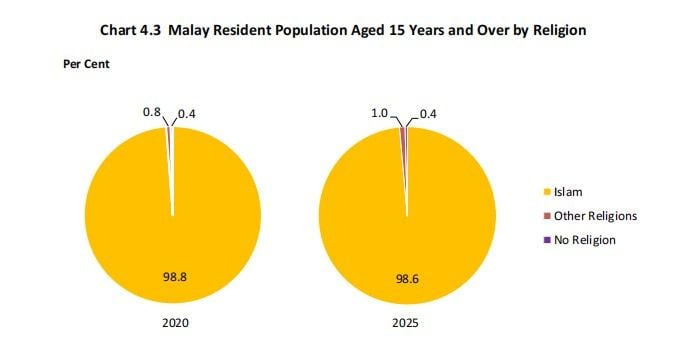
Among Malays, the proportion with no religion remained at 0.4 per cent in both years. Among Indians, it rose slightly from 2.2 per cent to 3.2 per cent.
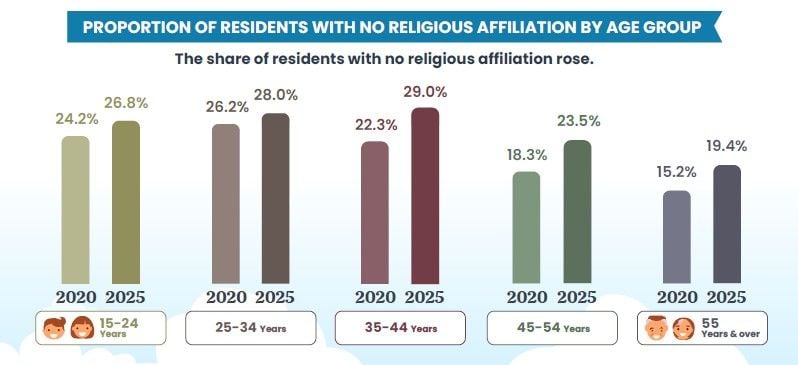
Younger residents were more likely to report no religious affiliation.
Some 26.8 per cent of those aged 15 to 24 said they had no religion in 2025, compared with 19.4 per cent of those aged 55 and over.
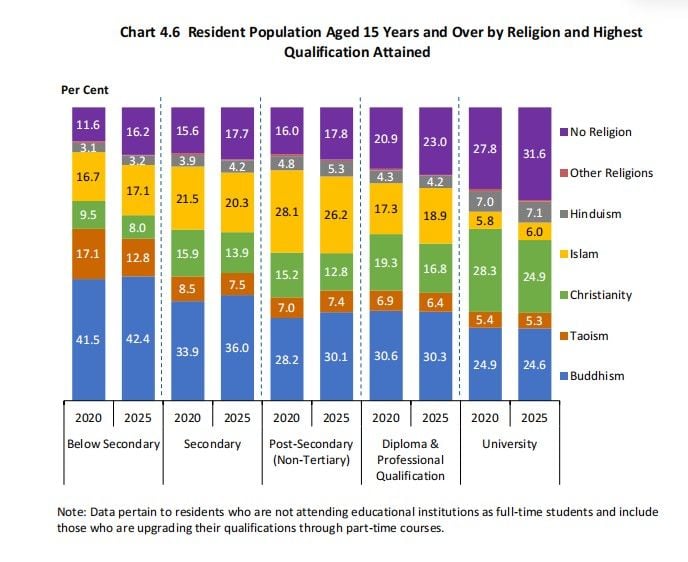
The survey noted that the decline in Christianity was more pronounced among university graduates, among whom the share identifying as Christian fell from 28.3 per cent in 2020 to 24.9 per cent in 2025.
Education, income and home ownership
The survey recorded continued improvements in education, household income and home ownership.
The proportion of residents aged 25 and over with post-secondary or higher qualifications rose from 58.3 per cent to 64.8 per cent between 2020 and 2025.
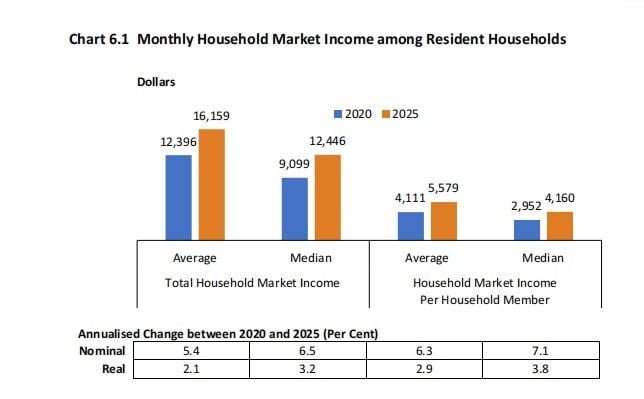
Median monthly household market income increased from S$9,099 to S$12,446 over the same period, representing an annual real increase of approximately 3.2 per cent after adjusting for inflation.
The proportion of households earning S$30,000 or more per month nearly doubled, from 7.4 per cent to 13.4 per cent.
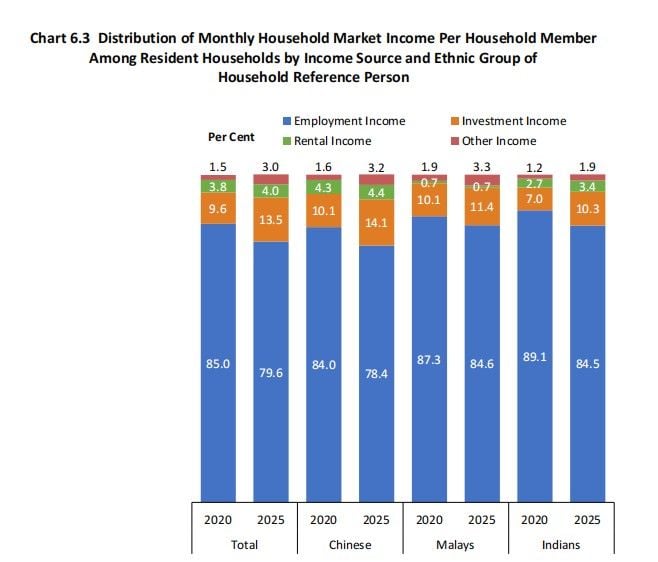
Investment income — including CPF interest — grew its share of total household market income from 9.6 per cent to 13.5 per cent. Home ownership rose from 87.9 per cent to 91.2 per cent.
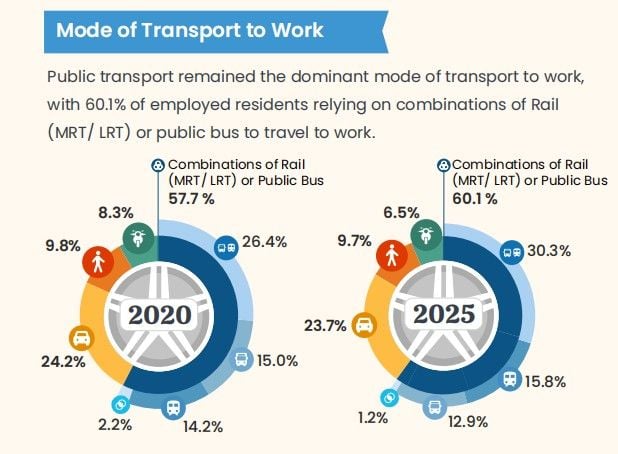
Public transport remained the dominant mode of travel to work, with 60.1 per cent of employed residents commuting by public bus, MRT, LRT or a combination of these modes in 2025, up from 57.7 per cent in 2020.
The GHS was conducted as part of the Comprehensive Labour Force & Household Survey 2025, which also incorporated the Comprehensive Labour Force Survey conducted yearly by the Ministry of Manpower.