Singapore coffee shops upgrade toilets under government grant scheme as uptake grows
Twelve coffee shops have completed toilet renovations or begun deep-cleaning works under two NEA grants, as authorities receive 171 applications since the scheme opened in November 2025.
- NEA received 171 grant applications since November 2025 to fund coffee shop toilet upgrades.
- Operators may claim up to 95 per cent of renovation costs, capped at S$50,000 per premises.
- Over 280 enforcement actions were taken in 2025 against coffee shops for hygiene lapses.

Twelve coffee shops across Singapore have completed toilet renovations or begun deep-cleaning works under two government grant schemes, as authorities report growing interest among operators in upgrading facilities that have long drawn complaints from patrons.
The National Environment Agency (NEA) has received 171 eligible applications since the grants opened on 3 November 2025 — 142 for the renovation grant and 29 for the deep-cleaning grant.
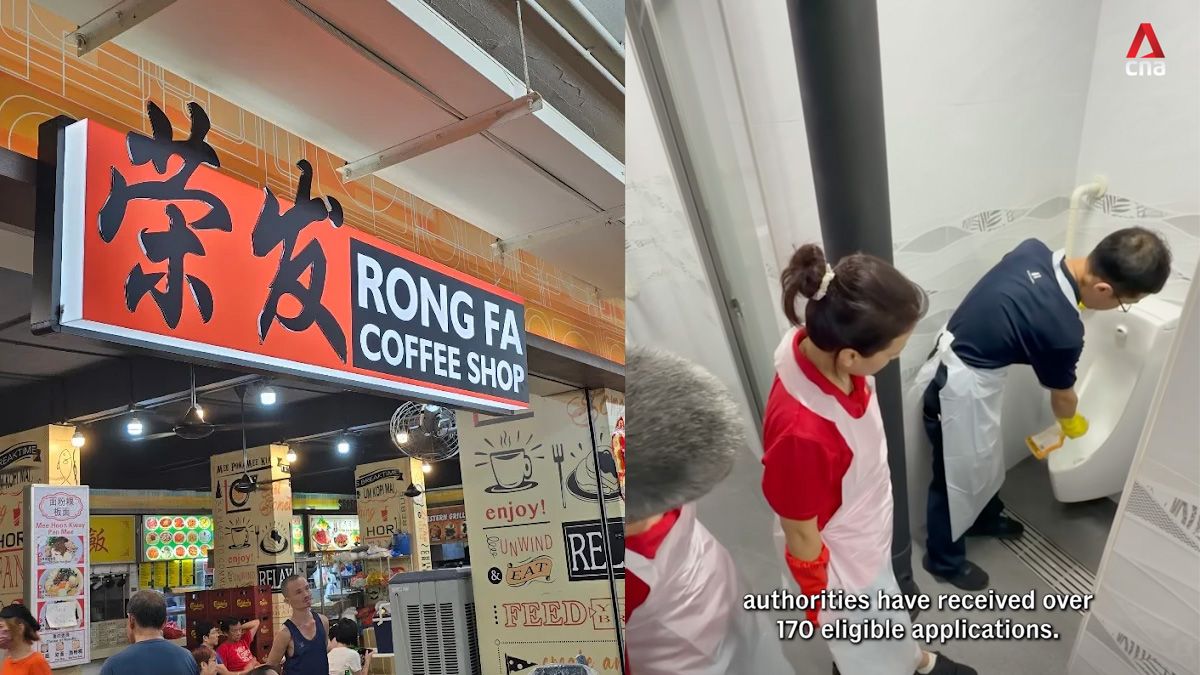
Senior Minister of State for Sustainability and the Environment Janil Puthucheary announced the figures during a site visit to Rong Fa Coffee Shop in Clementi on 15 May, where both grants have been applied.
"This is heartening. It tells us that the coffee shop operators are interested in renovating, redesigning and improving the accessibility and hygiene of their toilets," Dr Puthucheary told reporters on the sidelines of the visit.
He also called on users to take responsibility for shared amenities. "It's important for us to have these clean, accessible toilets in our heartlands, close to our homes, but it's just as important that we behave with some respect for these shared spaces," he added.
Grants and eligibility
The two grants were introduced by NEA in March 2025 following recommendations by the Public Toilets Taskforce, which submitted its findings to the Minister for Sustainability and the Environment in February 2025.
The Coffeeshop Toilet Renovation Grant covers up to 95 per cent of renovation costs, capped at S$50,000 per coffee shop. It is intended to improve toilet design, features and ease of maintenance.
The Coffeeshop Toilet Deep-Cleaning Grant co-funds up to 95 per cent of the cost of a two-year deep-cleaning contract, capped at S$25,000. Priority is given to smaller, non-chain operators that may need greater financial support.
As a condition of both grants, operators must ensure that in-house toilet cleaners are trained and certified under the Happy Toilet Programme, administered by the Restroom Association (Singapore).
Rong Fa Coffee Shop: a case study
Rong Fa Coffee Shop's director, Jenny Shi, applied for both grants when applications opened in November, having sought an opportunity to overhaul facilities that had deteriorated since she took over the premises in 2019.
Renovation works were carried out over 10 days between January and February 2026, completing ahead of Chinese New Year. Shi spent approximately S$49,000 (approximately US$38,300), with 95 per cent subsequently reimbursed under the grant.
The scope of works included new fittings and automated flushing systems in cubicles, improved lighting, and an upgraded accessible female toilet fitted with a new sink, mirror and hand dryer.
In the communal sink area, storage was added beneath auto-faucet basins. Larger wall and floor tiles with fewer grooves were installed to reduce grime accumulation and simplify routine cleaning.
Shi told CNA that the high upfront cost had initially given pause for thought but that ongoing maintenance challenges left the coffee shop with little choice. "Dirt kept accumulating in old fixtures and hard-to-reach crevices despite regular cleaning," she said in Mandarin.
The renovation has cut cleaning time by approximately 10 minutes per session. The toilet is cleaned three times daily, with deep-cleaning conducted twice a month at S$400 per session.
Patrons and stallholders welcome changes
Regular visitors to Rong Fa said the improvements had been immediately noticeable. Diner Desmond Tan, 51, who visits the coffee shop almost daily, told The Straits Times: "It feels very bright and clean now compared with before. It's more hygienic."
Hong Khu Tee, 57, who has operated a dim sum stall at the coffee shop for 12 years, told CNA that the persistent smell of urine that had plagued the old facilities was now gone. "Many customers tell me that this renovation makes it look like a hotel toilet," he said in Mandarin.
Taxi driver Chua Chong Hoi, 68, told CNA he welcomed the improved ventilation and non-slip floor tiles. "Last time the floor was wet and slippery. Now with the new floor tiles, it is safer for children and seniors," he said in Mandarin.
Not all patrons were fully convinced the improvement would be sustained. A patron who identified himself only as Bala, 60, told CNA the new toilet was "a bit better" but added that its condition would depend on maintenance over time.
Other participating coffee shops
Alongside Rong Fa, Coffee Sense at Ang Mo Kio and Kim San Leng are among the 12 coffee shops that have completed renovation works or begun deep-cleaning programmes. More are expected to follow as applications are processed.
Outside the coffee shop sector, Sport Singapore was the first institution to adopt the Public Toilets Taskforce's design recommendations, implementing improved ventilation and anti-slip impermeable tiles at its ActiveSG facility in Jurong East.
The taskforce, set up in 2024, conducted a study that found dirty public toilets remained a persistent problem despite years of public awareness campaigns. Its recommended design features were communicated to more than 1,300 premises and relevant parties.
Enforcement against non-compliant operators
The grant scheme runs alongside continued enforcement action against operators who fail to meet sanitation requirements. Approximately 280 enforcement actions were taken in 2025, with more than 200 targeting coffee shop owners for lapses including failure to maintain sanitary fittings in good working condition.
Under the Environmental Public Health Act, lapses in public toilet cleanliness can result in fines of up to S$5,000 for first-time offenders.
NEA took approximately 150 enforcement actions specifically against coffee shop operators that failed to comply with environmental sanitation requirements, including toilet cleanliness standards, following stepped-up audits, particularly targeting recalcitrant operators.
The Singapore Food Agency (SFA) suspended 61 coffee shops for toilet-related lapses under its Points Demerit System, which requires licensed food establishments to maintain proper hygiene standards across their premises, including toilets.
Not all operators have moved to apply for the grants. Some previously indicated concerns over upfront costs, potential business disruption during renovation works, and the requirement to pay in full before reimbursement. Others said they saw limited need for upgrades given constrained toilet space.
The Public Hygiene Council is also expanding its Neighbourhood Toilets Community Group programme to more coffee shop operators, under which community volunteers monitor toilet cleanliness and notify operators of defects or maintenance issues.
Criticism of grants
The grants have also faced public opposition. Associate Professor Jack Sim, a sanitation advocate, described the initiative as a "grave mistake" in a series of public statements.
Sim argued that the Ministry of Sustainability and the Environment (MSE) is unfairly subsidising private businesses, some of which are owned by wealthy entities.
Sim suggested that instead of providing public funding, the government should implement stricter enforcement, including surprise inspections and a public grading system similar to food hygiene ratings. He claimed that 60 per cent of coffee shop toilets remain dirty and argued that higher fines would be more effective than subsidies.
In response to such criticisms, the government has defended the grants as a necessary intervention for public health. Senior Parliamentary Secretary for Sustainability and the Environment Baey Yam Keng previously stated that coffee shops serve as vital social hubs, particularly for the elderly, and require support due to high footfall and limited cleaning manpower.