TAFEP logged 163 race-based workplace discrimination complaints from 2016 to 2025
Minister for Manpower Dr Tan See Leng told Parliament that TAFEP received 163 race-based workplace discrimination complaints between 2016 and 2025, about five per cent of all such complaints lodged.


A total of 163 race-based workplace discrimination complaints were lodged with the Tripartite Alliance for Fair and Progressive Employment Practices (TAFEP) between 2016 and 2025, Parliament heard, accounting for about five per cent of all workplace discrimination complaints received over the same period. The figure was disclosed by Minister for Manpower Dr Tan See Leng in a written reply.
The written reply was filed in response to a question from Non-constituency MP Eileen Chong from the Workers' Party, who asked for a decade-long breakdown of race-based workplace discrimination by race, and by sector and occupation type, including professional, managerial, executive and technical (PMET) as well as non-PMET roles.
Chong's question referenced a finding on "return deficit" in a recent report by the Centre for Research on Islamic and Malay Affairs (RIMA), alongside the 2023 Fair Employment Practices survey finding that race was the second most common basis of workplace discrimination.
In his reply, Dr Tan stated that the top three sectors with race-based complaints were "Administrative and Support Service Activities, Wholesale and Retail Trade, and Education."
Beyond identifying these sectors, the Minister did not provide the requested breakdown of complaints by race, as this level of disaggregation was not addressed in the reply.
Similarly, the Minister did not provide the requested breakdown by PMET and non-PMET occupation type, leaving unanswered which categories of workers were more likely to lodge such complaints.
The premise of Chong's question draws on two separate sources. Ministry of Manpower data bears out the 2023 Fair Employment Practices survey finding: race was the second most common basis of workplace discrimination reported by resident employees in 2023, at 1.7 per cent, behind age discrimination at 2.6 per cent and ahead of nationality at 1.6 per cent. During job search, race was likewise the second most cited basis of discrimination in 2023, at 5.1 per cent, again behind age at 18.1 per cent.
The RIMA reference points to the report "Intergenerational Mobility Within the Malay Community in Singapore," commissioned by AMP Singapore and published by RIMA in 2026, drawing on a community survey of 267 respondents and 33 interviews conducted between October 2024 and January 2025.
The report defines "return deficit" as occurring "where substantial investments in education or training yield smaller-than-expected gains in wages, job security, or career progression," adding that the term was used in the study "to describe how Malay respondents' educational credentials and effort did not always translate into commensurate occupational rewards compared to other races."
Listing "Return Deficit" among its cross-cutting mechanisms, the report's executive summary states that "even with substantial investment in education or training, some respondents experienced smaller-than-expected occupational or financial gains due to biases."
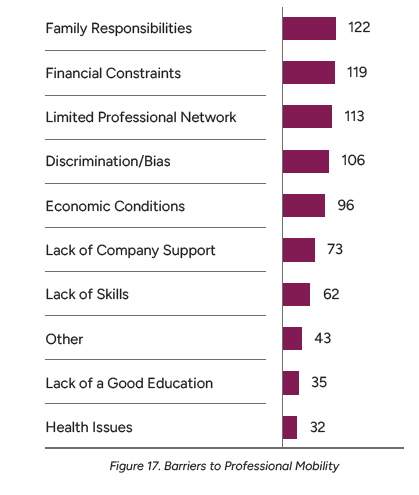
Elsewhere, it notes that "interviewees described encountering racial discrimination, having to work harder to prove their competence, and being overlooked during hiring or promotion processes despite holding necessary certifications." Discrimination or bias was cited by 106 of the 267 survey respondents as a barrier to professional mobility, the fourth most commonly selected barrier after family responsibilities, financial constraints and limited professional networks.
Interview respondents in the report gave firsthand accounts of this dynamic. One said: "I've been to courses with people [from the majority race] and realise that they are working in positions that I wanted to work in. And that even though I have more job experience, I've never gotten a call back."
Another recounted: "Older colleagues, or even family members – older ones who've been working for a long time, always said that it's crazy that you have to do something two times better for you to be on the same level as a person who's giving their bare minimum. And that person is of a majority race."
A third described being told by a former deputy director that an organisation did "not want Malay/Muslims," while a fourth recalled hiring managers who "just shove aside applications coming from Malays."
Turning to the trend picture over the decade, the 163 complaints and five per cent share disclosed by Dr Tan offer a national aggregate but stop short of the granular, race-by-race and occupation-by-occupation trend analysis sought by Chong.
Without that breakdown, it remains unclear from the Parliamentary record whether particular racial groups or particular occupational tiers have seen a rising or falling share of complaints over the 2016 to 2025 window, or whether the sectoral concentration in administrative support, retail and education has shifted over time.
Some context for that sectoral concentration can be drawn from the RIMA report's workforce data, which shows Malays overrepresented relative to the resident population in Administrative and Support Services (10.7 per cent of the Malay workforce against 5.9 per cent nationally) and in Public Administration and Education (16.2 per cent against 13.1 per cent nationally), two of the three sectors Dr Tan identified as having the most race-based complaints. Malays were, by contrast, underrepresented in Wholesale and Retail Trade, the third sector named by the Minister, at 9.1 per cent against 14.9 per cent nationally.