Temasek portfolio reaches S$518 billion as investment gains outweigh global uncertainty and Middle East conflict
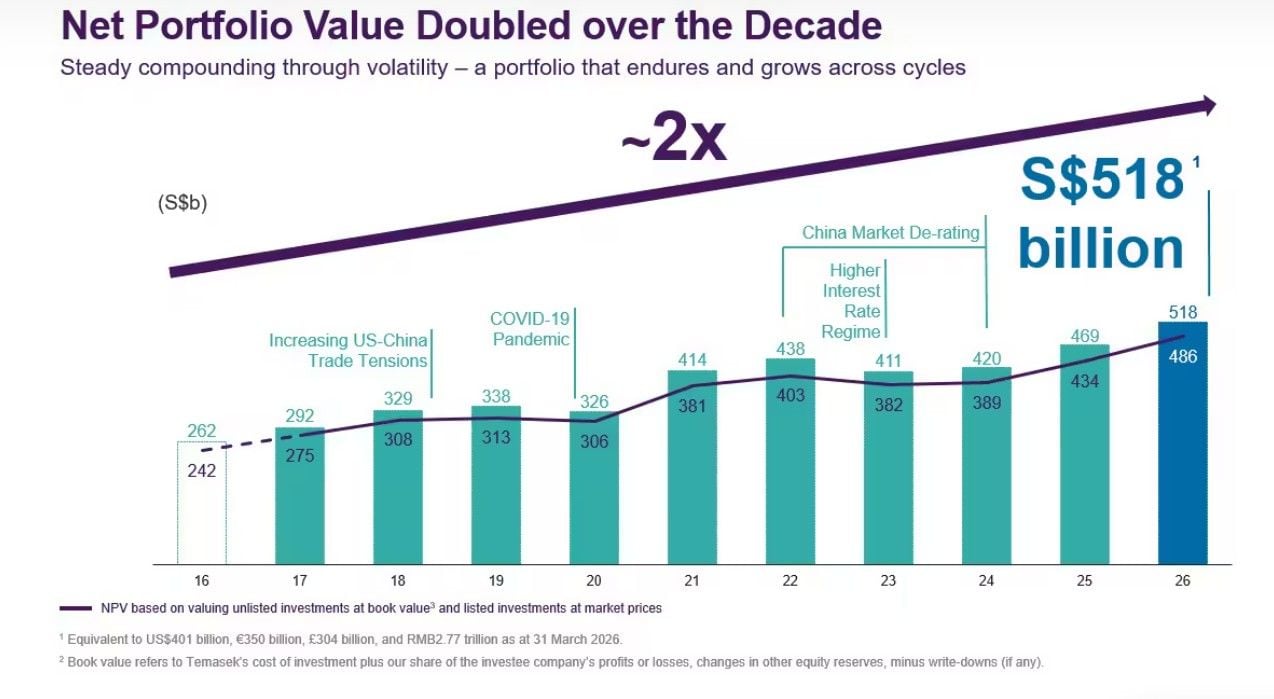
Temasek Holdings grew its net portfolio value by 10.5 per cent to S$518 billion (US$401 billion) in the financial year ended 31 March 2026, supported by gains in Singapore-listed companies and strategic divestments despite heightened geopolitical tensions and market volatility.

Temasek Holdings reported a 10.5 per cent increase in its net portfolio value (NPV) to S$518 billion (US$401 billion) for the financial year ended 31 March 2026, as strong gains from Singapore-listed companies and successful divestments helped offset heightened geopolitical tensions and volatility across global financial markets.
According to a Temasek press release issued on 8 July 2026, the state investment company continued to expand its portfolio despite an increasingly complex global environment marked by conflict in the Middle East, uneven economic recovery and currency fluctuations.
The latest NPV represents an increase from S$469 billion recorded a year earlier under a mark-to-market basis of valuation.
Although the portfolio continued to grow, the pace moderated from the 11.9 per cent increase reported between the 2024 and 2025 financial years.
Temasek said its performance reflected the resilience of its diversified global investment strategy, with Singapore-based listed companies accounting for a significant share of the gains alongside proceeds from several major divestments.
Polycrisis defines today's investment landscape
Chief Executive Officer Dilhan Pillay Sandrasegara described today's operating environment as the most challenging the investment company has experienced in five decades.
"We're not simply in a VUCA (volatility, uncertainty, complexity and ambiguity) world, we are in a polycrisis world," he said in a video address accompanying the release.
Pillay said Temasek had nevertheless sustained the momentum built over recent years despite multiple overlapping geopolitical and economic challenges.
"The present environment is the most complex that we've seen in five decades," he said.
He pointed to encouraging recoveries across parts of Asia, particularly China and India, while acknowledging that external events had weighed on investment returns.
"We saw a rebound in China. India has done very well for us, although the last year has been challenging because of exchange rate volatility," he said.
However, he added that the conflict in the Middle East significantly affected public markets during the closing months of the financial year.
According to Pillay, Temasek's public markets portfolio had generated "very acceptable" returns up to the end of February before market sentiment deteriorated.
"Our NPV would have been about 2 per cent higher if not for the impact of these events on public markets," he said.
He noted that financial markets rebounded during April and May, allowing the portfolio to recover most of the losses experienced during the earlier sell-off.
"The vast majority of losses was recovered, which gives us confidence that our public markets strategies remain relevant for longer-term portfolio performance," he added.
Singapore remains the foundation of the portfolio
Singapore-based companies continued to form the backbone of Temasek's investment portfolio, accounting for more than 40 per cent of total holdings.
Major listed investments include DBS, Singtel and Singapore Airlines, whose stronger market performance contributed significantly to the year's portfolio growth.
Alongside investment gains, Temasek completed several notable divestments during the financial year.
These included the sale of Dutch seed producer Axia Vegetable Seeds and Schneider Electric India.
The company also divested its controlling stake in United States-headquartered Global Health Exchange while retaining an ongoing interest in the business.
During the financial year, Temasek invested S$51 billion while divesting S$31 billion, resulting in net investments of S$20 billion.
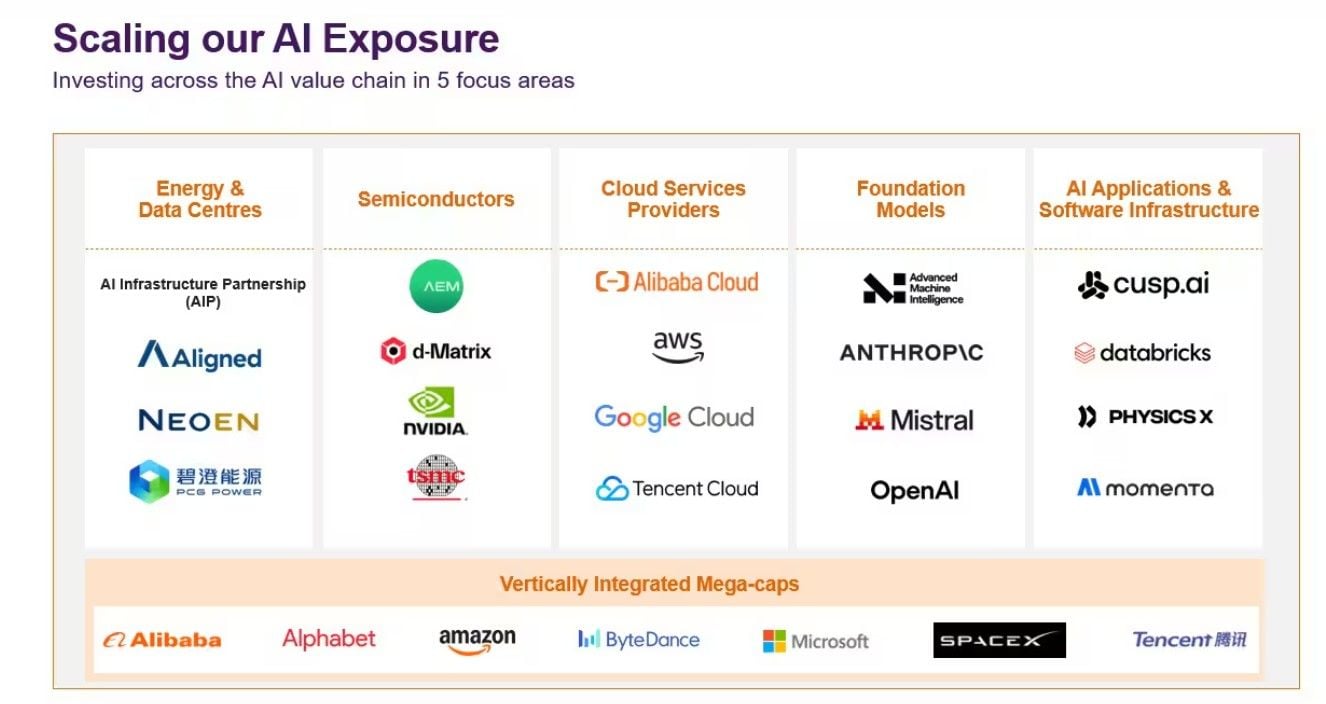
Looking ahead, the investment company said it intends to increase allocations towards artificial intelligence, infrastructure and private credit as part of its longer-term investment strategy.
Shareholder returns remain resilient despite currency headwinds
Temasek reported a one-year total shareholder return (TSR) of 10.5 per cent in Singapore dollar terms.
Measured in United States dollar terms, shareholder returns reached 14.8 per cent.
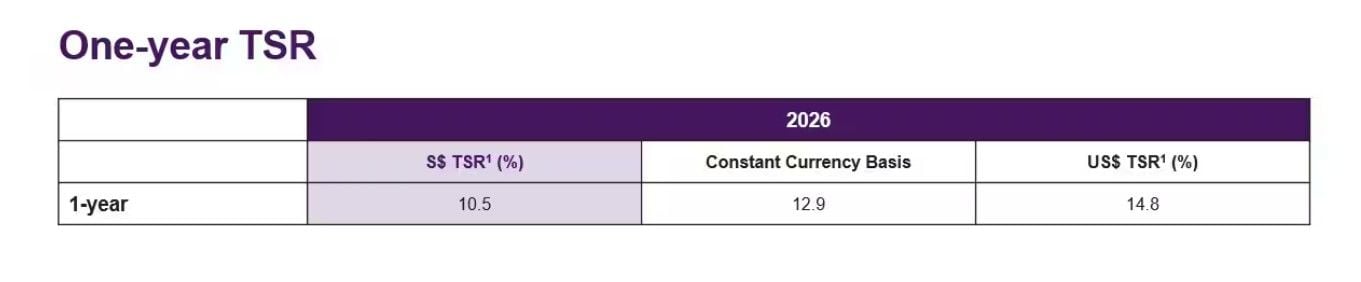
The company said the appreciation of the Singapore dollar reduced the reported one-year return by approximately two percentage points.
Longer-term returns presented a mixed picture.
Five-year shareholder returns stood at 4.6 per cent, reflecting the prolonged weakness in China's capital markets between 2021 and 2024.
Meanwhile, the 10-year total shareholder return improved to 7.1 per cent from 5.8 per cent a year earlier.
The 20-year shareholder return eased slightly to 6.8 per cent compared with 7.4 per cent reported last year.
For the first time, Temasek has fully transitioned to a mark-to-market valuation methodology for all unlisted investments.
Under this approach, private assets are valued according to prevailing market conditions rather than historical book values.
On a book value basis, Temasek said its net portfolio value would have been S$486 billion
United States remains Temasek's largest investment destination
Looking ahead, Temasek said it remains confident in Singapore's resilience despite continuing geopolitical uncertainty and disruptions to global energy markets.
According to the Temasek press release, Singapore's strong economic fundamentals, sound institutions and policy flexibility position it well to navigate an increasingly uncertain global environment.
The US continues to be the largest destination for Temasek's direct global investments, reflecting its confidence in the country's innovation ecosystem and capital markets.
"We see attractive opportunities given its leadership in innovation, particularly across the AI value chain, supported by deep public and private capital markets," Temasek said.
The company added that it would continue to remain disciplined on valuations while maintaining a measured approach to managing investment risks.
Speaking during a media briefing, Temasek International Chief Investment Officer Rohit Sipahimalani acknowledged that the weakening United States dollar had created additional uncertainty for investors.
However, he said stronger corporate earnings and continued economic expansion continued to support investment opportunities.
"If company earnings are growing and the economy is growing, reasonable returns can be expected," he said.
Sipahimalani added that the United States remained a core investment market for Temasek.
"We've been allocating about 50 per cent of our capital there every year, and you can see it's been inching up as a share of our total portfolio," he said.
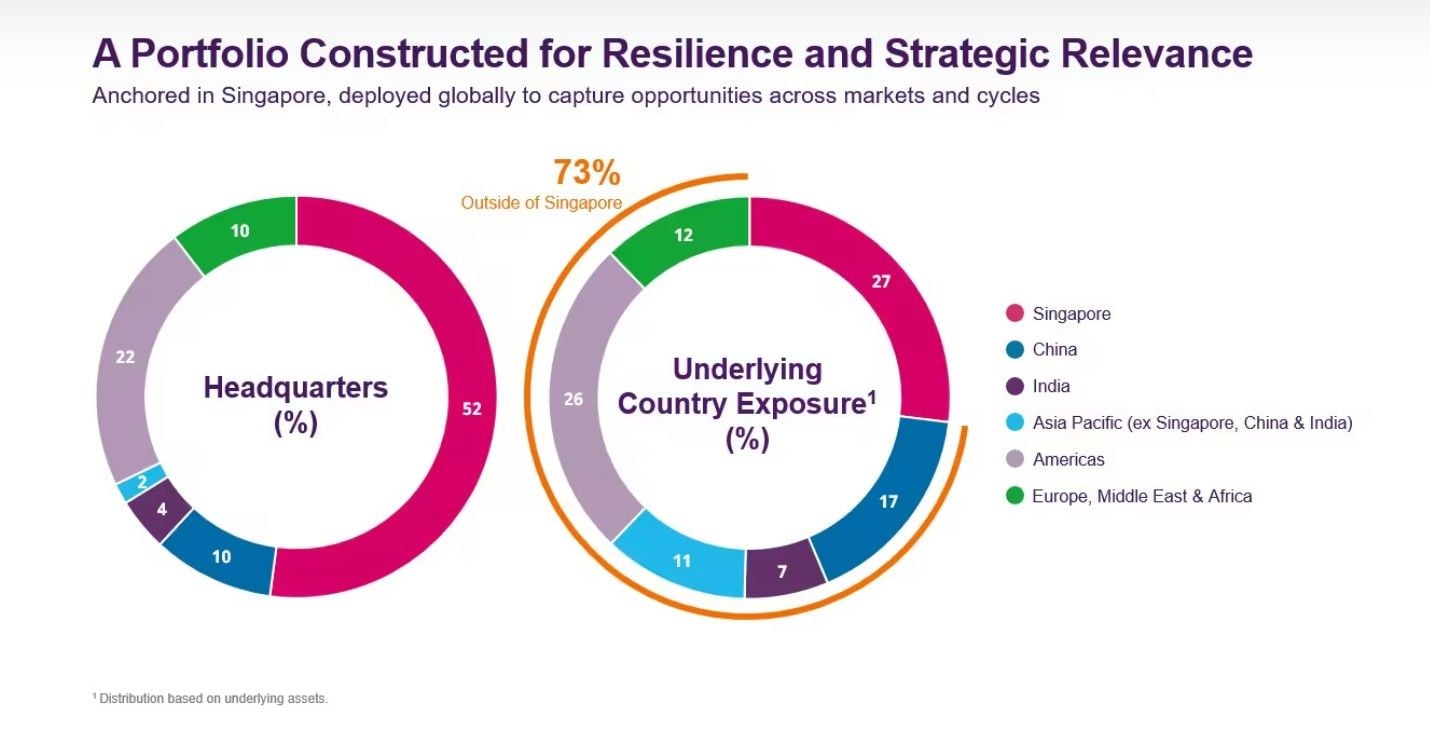
Reflecting that strategy, investments across the Americas increased to 26 per cent of Temasek's overall portfolio in 2026, compared with 24 per cent a year earlier.
China strategy shifts towards structural growth sectors
While Temasek reaffirmed its long-term commitment to China, its portfolio exposure declined modestly during the year.
China accounted for 17 per cent of Temasek's investments in 2026, down from 18 per cent in the previous financial year.
India also represented a slightly smaller share of the portfolio, easing from 8 per cent to 7 per cent.
According to the Temasek press release, China's export sector has remained resilient even as domestic consumption continues to recover unevenly.
The company attributed the slower recovery in household spending partly to ongoing weaknesses within China's property market.
Chief Executive Officer of Temasek Global Investments Chia Song Hwee said those structural challenges required a more selective investment approach.
"Those are somewhat structural, and therefore we can't invest assuming that it will reverse itself," he said during the media briefing.
Instead, Temasek said it is directing capital towards industries less dependent on consumer spending or property-related activity.
These include biotechnology, robotics, artificial intelligence-related technologies and advanced manufacturing, sectors that the company believes offer stronger long-term growth prospects driven by innovation.
India continues to offer long-term opportunities
Although India's share of Temasek's portfolio edged lower during the financial year, the investment company maintained a positive long-term outlook for the market.
Temasek said India's structural growth story remains supported by favourable demographic trends, rapid infrastructure development and the continued expansion of its middle class.
Temasek acknowledged that equity markets had experienced heightened volatility and that energy-related pressures had created short-term uncertainty.
Nevertheless, it said these factors had not altered its long-term investment thesis.
The company said it would continue focusing on sectors expected to benefit from India's domestic growth, including consumer businesses, financial services and healthcare.
Temasek stresses diversified portfolio to preserve growth amid global uncertainty
While global markets were affected by the conflict in the Middle East, currency volatility and uneven economic performance across major economies, Temasek said its diversified portfolio enabled it to preserve growth and generate positive returns.
The transition to a full mark-to-market valuation methodology also provides investors with a more transparent reflection of the current value of its unlisted assets, bringing them into line with prevailing market conditions.
Despite acknowledging that the investment environment remains unusually complex, Temasek said it sees expanding opportunities in innovation-led sectors, particularly artificial intelligence, digital infrastructure, biotechnology and advanced manufacturing.
Its continued allocation of capital to the United States, selective investment strategy in China and long-term confidence in India's structural growth illustrate an investment approach focused on capturing sustainable returns while navigating heightened global uncertainty.
The results reinforce Temasek's strategy of maintaining a diversified global portfolio anchored by Singapore while steadily expanding exposure to industries and markets expected to shape long-term economic growth.