Death toll from Shanxi mine gas explosion revised to 82 amid administrative confusion
A gas explosion at the Liushenyu coal mine in Shanxi Province has killed at least 82 people, with authorities revising the initial death toll down from 90 due to severe discrepancies in company personnel logs that left over 100 workers unregistered before the blast.
- A gas explosion at the Liushenyu coal mine in Shanxi Province killed 82 workers and injured 128 others.
- Management failed to register 123 miners, leading to severe discrepancies and confusion over initial casualty figures.
- Corporate executives have been detained under criminal control as state investigators probe allegations of major illegal operations.

A catastrophic gas explosion at a coal mine in northern China has claimed the lives of at least 82 workers and left two others missing, according to official statements from regional authorities. The disaster occurred at the Liushenyu coal mine, located in Qinyuan County within Changzhi City, Shanxi Province.
The blast took place at approximately 19:29 on Friday 22 May 2026, marking one of the deadliest industrial accidents to hit the Chinese mining sector in recent years.
Initial state media dispatches published by the official Xinhua News Agency had placed the death toll at 90 on Saturday afternoon. However, municipal officials formally revised the casualty figures downward during a press conference held in Changzhi City at 22:30 on Saturday 23 May 2026.
Mayor Chen Xiangyang confirmed that 82 individuals were deceased, two remained unaccounted for, 128 had sustained injuries requiring hospitalisation, and 35 miners had escaped without injury and returned home.
According to local emergency management officials, the initial reporting errors and fluid casualty figures resulted directly from the chaotic post-disaster environment and severe negligence by the mine operator regarding staff tracking.
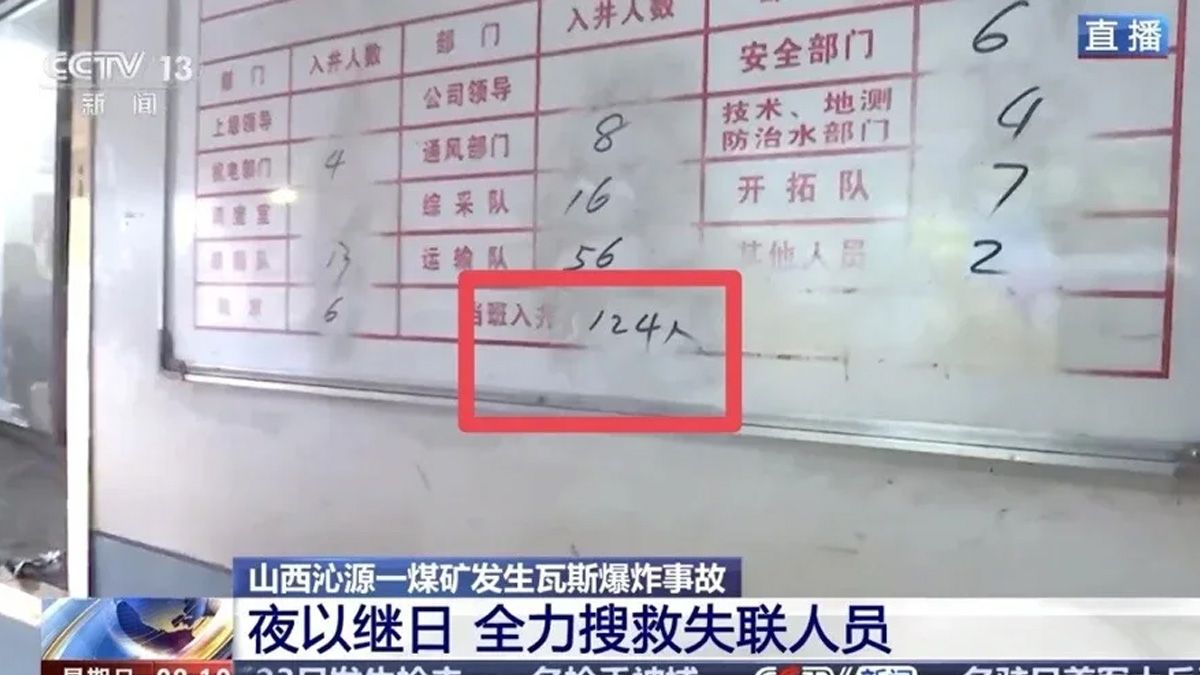
An investigation broadcast by the state television network China Central Television revealed a critical discrepancy between official electronic registry boards and the physical headcount underground. Regulations dictate that all mining personnel must pass biometric facial recognition scanners, undergo security checks, and register active electronic tracking cards prior to entering the mine shaft.
Despite these mandatory legal safety safeguards, the digital entry display board at the surface level showed that only 124 personnel were inside the mine facility at the time of the explosion. Subsequent cross-referencing by government investigators discovered that the actual number of workers deployed underground was 247. The state broadcaster noted that 123 miners had been allowed to descend into the shaft without leaving any valid tracking data or records in the system.
The rescue operation has faced severe logistical obstructions. Emergency services reported that the blueprints provided by the mining company did not match the actual layout of the subterranean tunnels, significantly impeding rescue personnel. China Central Television reported that the explosion occurred roughly 300 metres below the surface, triggering extensive structural collapses and severe internal flooding.
A force of 335 professional rescue workers and 420 medical staff were dispatched to the disaster site. Teams are currently running ventilation operations and pumping out floodwaters concurrently to access blocked chambers.
The state broadcaster reported that the mine is operated by the Shanxi Tongzhou Coal and Coke Group, which is also referred to locally as the Shanxi Tongzhou Group Liushenyu Coal Industry Company Limited. The facility has an annual production capacity of 1.2 million tonnes.
The National Mine Safety Administration had placed the Liushenyu facility on an official national watch list of disaster-prone operations in 2024, citing its high natural gas content. Local media outlets reported that the enterprise has faced multiple administrative penalties for safety violations in recent years.
The exact trigger for the gas blast remains under investigation by state safety bodies. However, a preliminary assessment by the local emergency bureau found that the corporate group had engaged in serious illegal operations. Xinhua News Agency reported that the actual controllers and senior executives of the company have been placed under formal state control and detained by police.
Survivors receiving emergency medical treatment described a rapid onset of toxic fumes rather than a distinct acoustic blast. One hospitalized miner, Wang Yong, recalled smelling a pungent sulfur odor resembling firecrackers, followed immediately by heavy black smoke.
Wang stated that he attempted to shout warnings to nearby colleagues to evacuate toward the exits, but observed several coworkers choking and collapsing before he lost consciousness. Another surviving worker stated that after hearing an intercom broadcast ordering an immediate evacuation due to an apparent gas leak, he ran for nearly two hours through the dark, obscured tunnels before losing clarity of consciousness.
Medical officials at the treating hospitals stated that the majority of the 128 injured miners are suffering from severe carbon monoxide poisoning. The clinical teams are utilising hyperbaric oxygen chambers to combat the toxicity and prevent the onset of delayed post-hypoxic encephalopathy and permanent brain damage.
Safety engineers speaking to the local press noted that gas explosions routinely cause a rapid surge in carbon monoxide levels, causing miners to succumb to asphyxiation and coma even in the absence of a secondary explosion.
The scale of the disaster has prompted interventions from the highest levels of the state apparatus. Chinese President Xi Jinping and Premier Li Qiang issued joint directives demanding an all-out scientific search and rescue effort to locate the missing personnel and treat the injured.
The instructions specified that local authorities must handle the aftermath appropriately, conduct a thorough investigation into the cause, and pursue criminal accountability in accordance with statutory law. The State Council has formally established a dedicated central accident investigation team, and Vice Premier Zhang Guoqing traveled directly to the disaster site in Shanxi Province to oversee the emergency response.
The accident has drawn international attention and formal messages of condolence from external political figures. In Taiwan, the Mainland Affairs Council released an official press statement on Saturday 23 May 2026 expressing deep sympathy to the victims.
On social media, Taiwan President Lai Ching-te published a message written in simplified Chinese characters conveying profound grief over the loss of life, offering condolences to the bereaved families, and stating that Taiwan stands ready to provide humanitarian assistance if required.
Premier Cho Jung-tai published a similar message of condolence on social media.
Shanxi Province serves as the primary domestic coal-producing region in China. Geographically larger than Greece and supporting a population of approximately 34 million residents, the province employs hundreds of thousands of industrial miners.
Official geological records show that Shanxi extracted 1.3 billion tonnes of coal last year, accounting for nearly one-third of the total national output.
Coal remains the dominant baseline energy source across China due to its low cost and high domestic availability, even as state economic planners accelerate a nationwide transition toward renewable green energy infrastructure.